14 Baby Clothes Organization Ideas for Small Spaces
Baby clothes are small, but they multiply fast. One drawer of newborn onesies becomes three sizes and a pile of hand-me-downs before the first birthday — and in a rental, there is rarely a spare room to absorb it all. The good news is that these baby clothes organization ideas work in the smallest nurseries and the tightest closets, and almost all of them are renter-friendly: no drilling, no built-ins, and nothing a landlord would object to. The system runs on three rules — sort by size, keep only the current size within reach, and rotate everything else out of the way — and it fits the wider approach in our guide to small apartment storage ideas.
1. Sort everything by size first, and label it
Before buying a single bin, empty the closet and dresser and sort every piece by size: newborn, 0–3 months, 3–6 months, and so on. Babies outgrow a size every few weeks in the first year, so mixed sizes are the main reason a small closet feels chaotic. Put the current size front and center, the next size just behind it, and everything larger in a labeled bin on a high shelf. Big, clear labels mean anyone doing laundry puts things back in the right place.
2. Add a second closet rod — no drilling needed
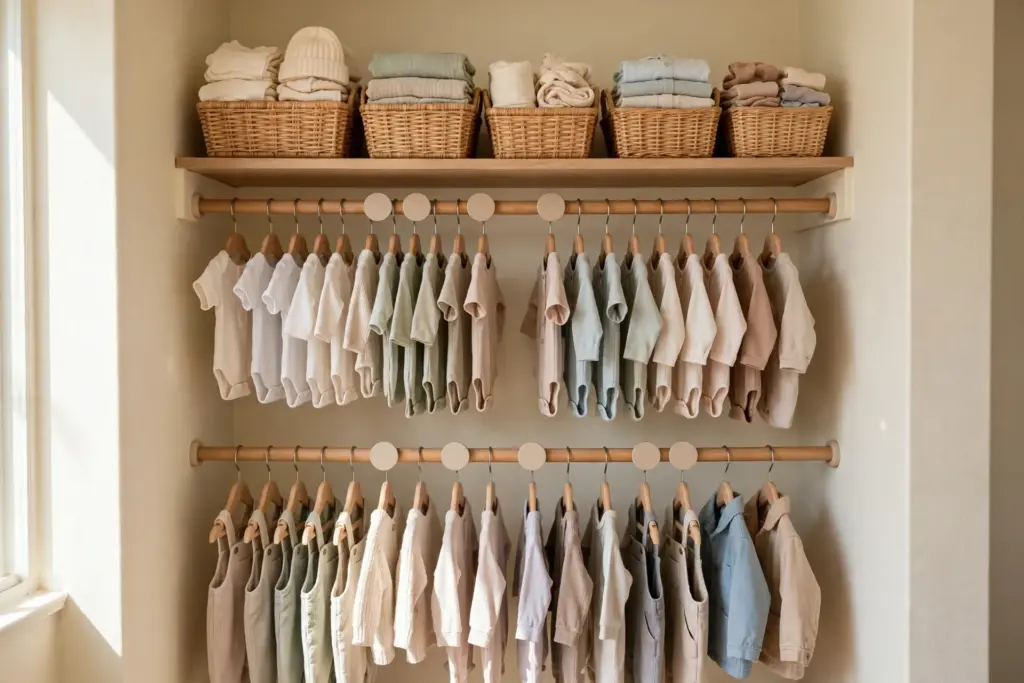
Baby clothes are only about 12 to 16 inches long, so a single closet rod wastes the whole lower half of the closet. A tension rod or clamp-on second rod, set about 32 to 34 inches from the floor, doubles the hanging space with no holes in the wall and no landlord permission needed. Hang tops and onesies above and pants, rompers, and outfits below. For more no-drill closet tricks, see our guide to small apartment closet organization.
3. Hang size dividers on the rod
Closet dividers are small rings that slide onto the rod between size groups, and they are the cheapest way to keep a baby closet readable. Label each one with a size range — NB, 0–3M, 3–6M, 6–9M — and hang the groups in order from left to right, with the current size at eye level in the middle. When your baby moves up a size, slide the divider along and the system updates in seconds.
4. File-fold onesies and sleepers so you can see them all
Flat stacks hide the bottom half of the drawer, which is how the same three onesies get worn while the rest sit forgotten. File folding fixes that: fold each onesie or sleeper into a small rectangle and stand it upright in the drawer, like files in a folder, so every pattern is visible the moment the drawer opens. A standard drawer holds roughly 15 to 20 file-folded onesies, and nothing gets buried.
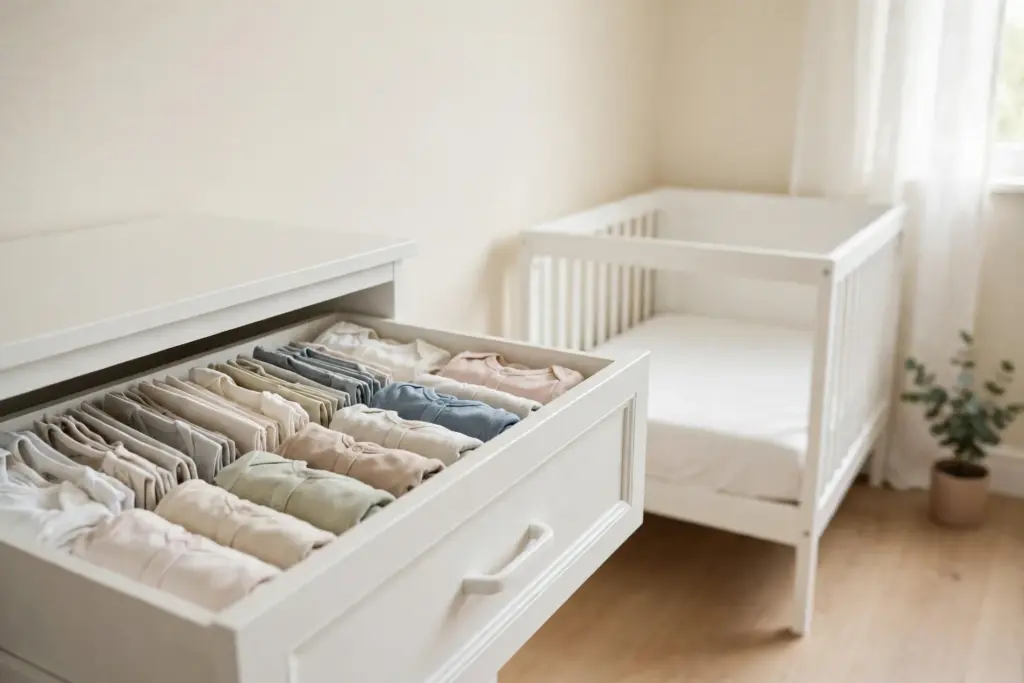
5. Give every dresser drawer one job
A drawer with a vague purpose becomes a junk drawer within a week. Assign each drawer a single category: top drawer for diapering supplies and small items, second for sleepers and sleep sacks, third for onesies, bottom for pants and outfits. Add a small fabric box inside the top drawer for socks, hats, and mittens. When every drawer has one job, getting the baby dressed becomes muscle memory — even at 3 a.m.
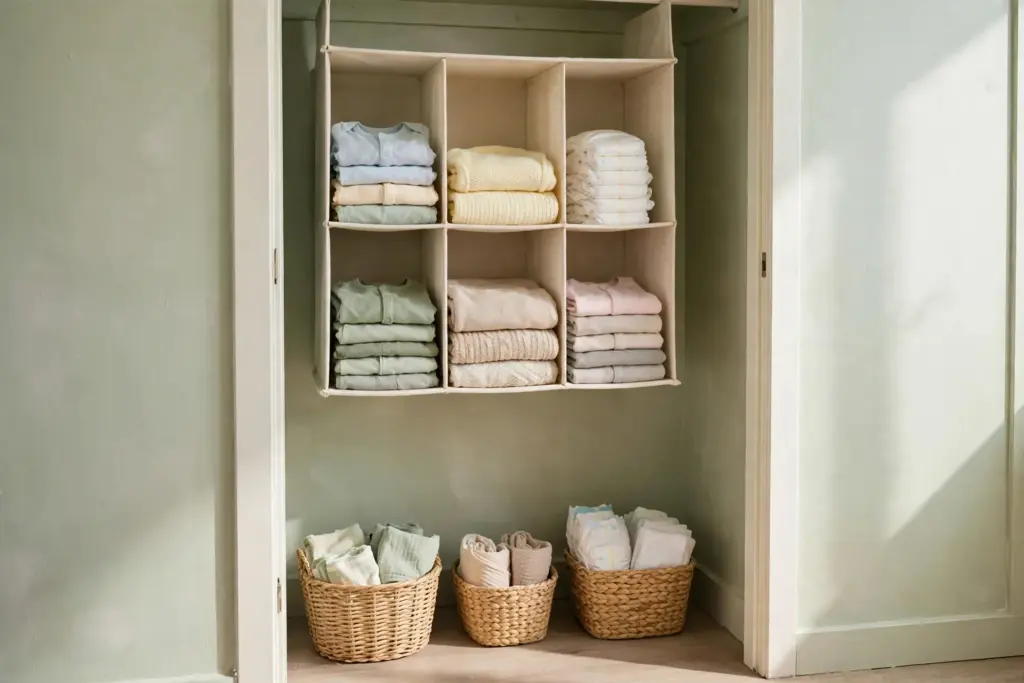
6. Hang a fabric shelf organizer in the closet
If the closet has a rod but no shelves, a hanging fabric organizer creates them in seconds: it hooks over the rod and gives you four to six cubbies for folded clothes, blankets, and sleep sacks. Use the top cubbies for the current size and the lower ones for the next size up, so the whole rotation lives in one place. Fabric organizers fold flat at move-out, weigh almost nothing, and cost far less than a built-in shelf.
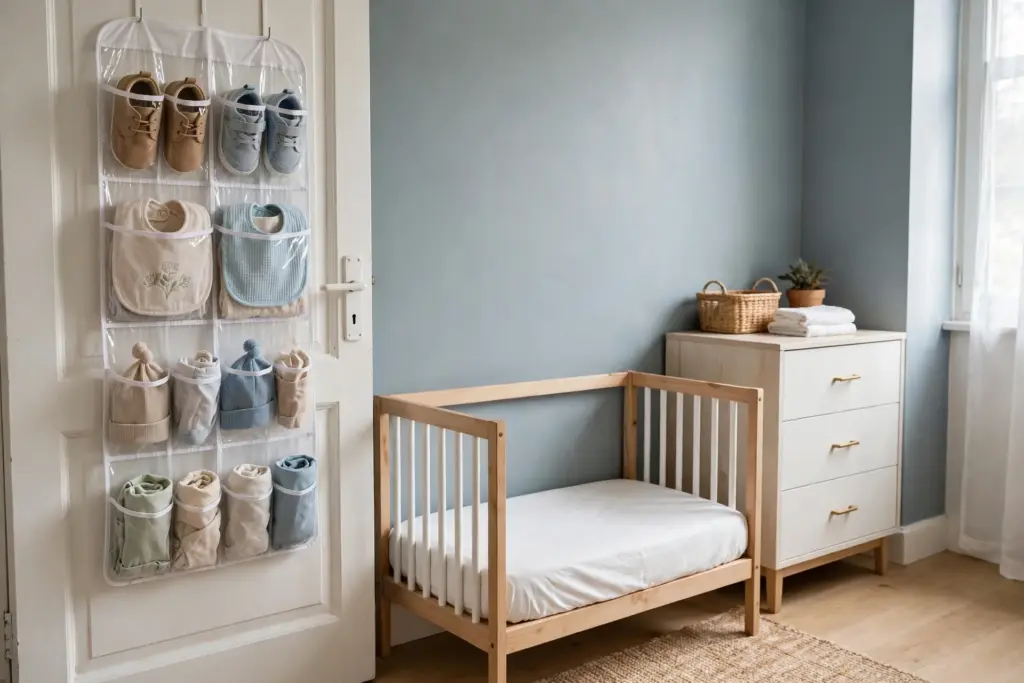
7. Use the back of the door for the small stuff
The back of the nursery door is free storage most renters never use. A clear over-the-door shoe organizer — the kind with rows of pockets — holds baby shoes, bibs, hats, socks, and rolled-up washcloths, all visible at a glance and all off the floor. It hooks over the door in seconds, leaves no marks, and comes down cleanly when you move. Keep daily items at adult eye level and use the lowest pockets for backstock like extra bibs and burp cloths.
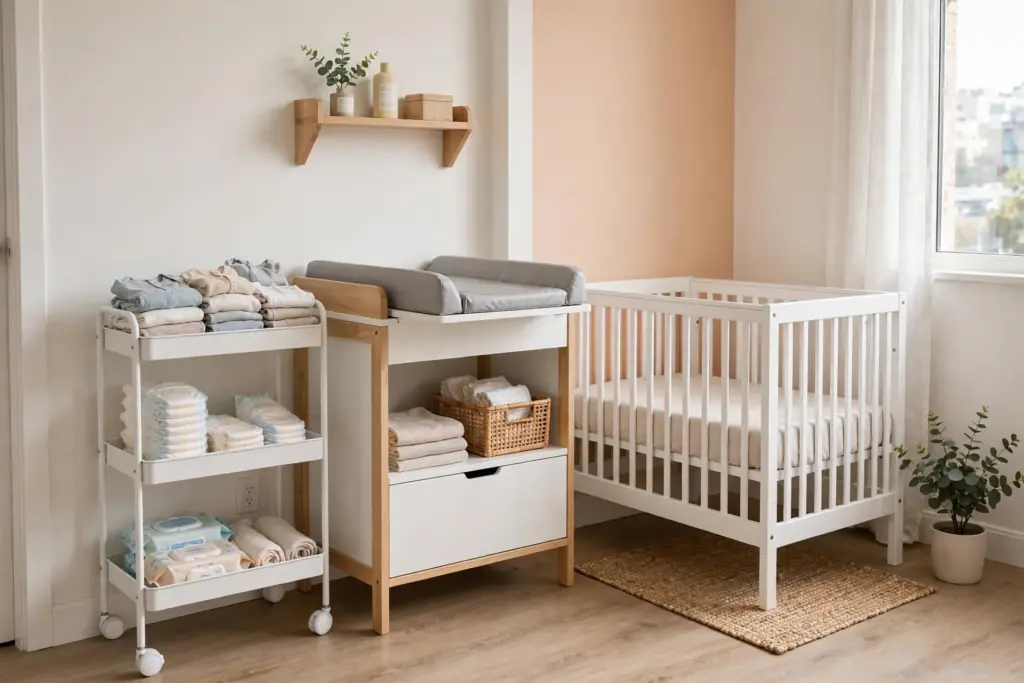
8. Roll a slim cart beside the changing table
A three-tier rolling cart is the renter’s answer to a missing changing station. Park it beside the changing table or the crib and load it by frequency: top tier for the current size’s onesies and sleepers, middle for diapers and wipes, bottom for burp cloths and extra blankets. Everything stays within arm’s reach during changes, and the whole cart rolls into a closet or behind a door when guests come over. It needs no permission, leaves no marks, and moves with you to the next apartment.
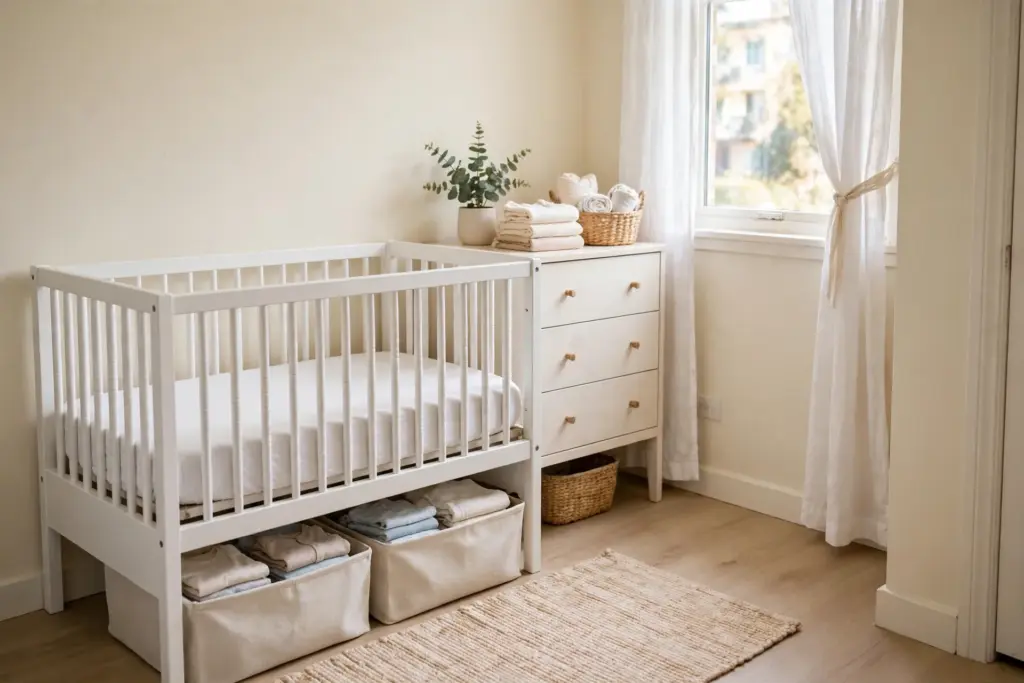
9. Slide labeled bins under the crib
Two shallow fabric bins slide neatly into the empty space under the crib. Use one bin for the next size up and one for out-of-season clothes, and label both on the side that faces out. Keep the bins low and flat so they slide freely, and never store anything inside the crib itself — safe sleep guidance from the American Academy of Pediatrics calls for a bare crib with only a fitted sheet.
10. Keep one “too small” bin always open
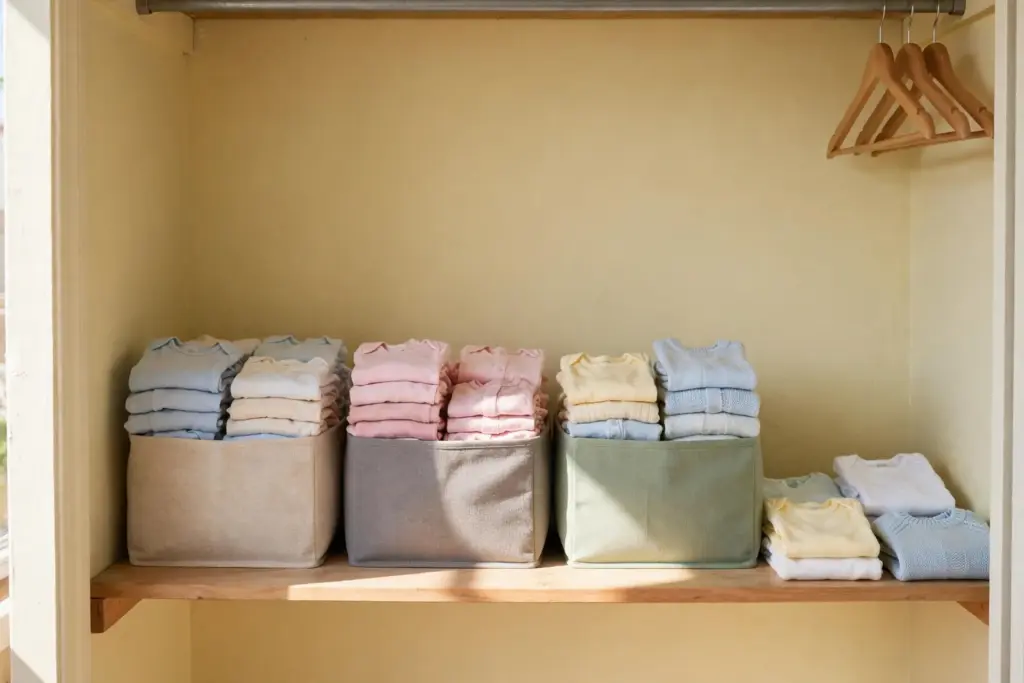
The fastest way to keep a baby closet honest is a single open bin labeled “too small.” Keep it on a low shelf or in the closet, and the moment an outfit feels snug, drop it in right away instead of folding it back into the drawer. When it fills up, wash the clothes and move them to a sealed bin on the top shelf or under the bed. The open bin stops outgrown clothes from sneaking back into the current-size rotation — the most common reason a dresser drawer overflows. As your child grows, the same rule keeps working; see our kid closet organization ideas for the next stage.
11. Stage the next size up, ready to grab
Babies do not grow on a schedule, and the next size is always needed on the night you least expect it. Keep one labeled bin or cubby with the next size up, washed and folded, right beside the current size — not buried in a sealed box on a high shelf. When the current size starts feeling tight, the next size is already in the rotation, with no emergency shopping trip or frantic closet dig. Top it up from the larger storage bin each time you do laundry.
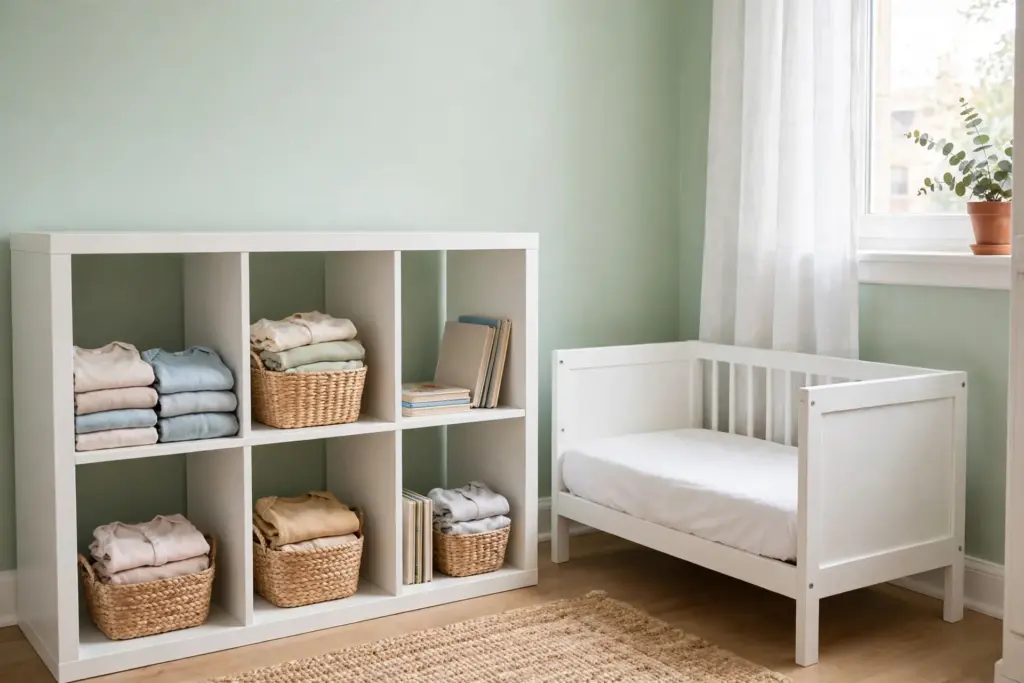
12. Choose cube storage that grows with your child
A cube storage unit is one of the few baby purchases that does not become useless in a year. Start with fabric bins inside the cubes for folded clothes, plus a basket for blankets and one for shoes. When the baby outgrows the clothes, the same cubes hold books, then toys, then school supplies — the unit stays, only the contents change. A two-by-two or two-by-three cube shelf fits most rental bedroom walls without blocking a door or window, and it moves with you without a single screw in the wall.
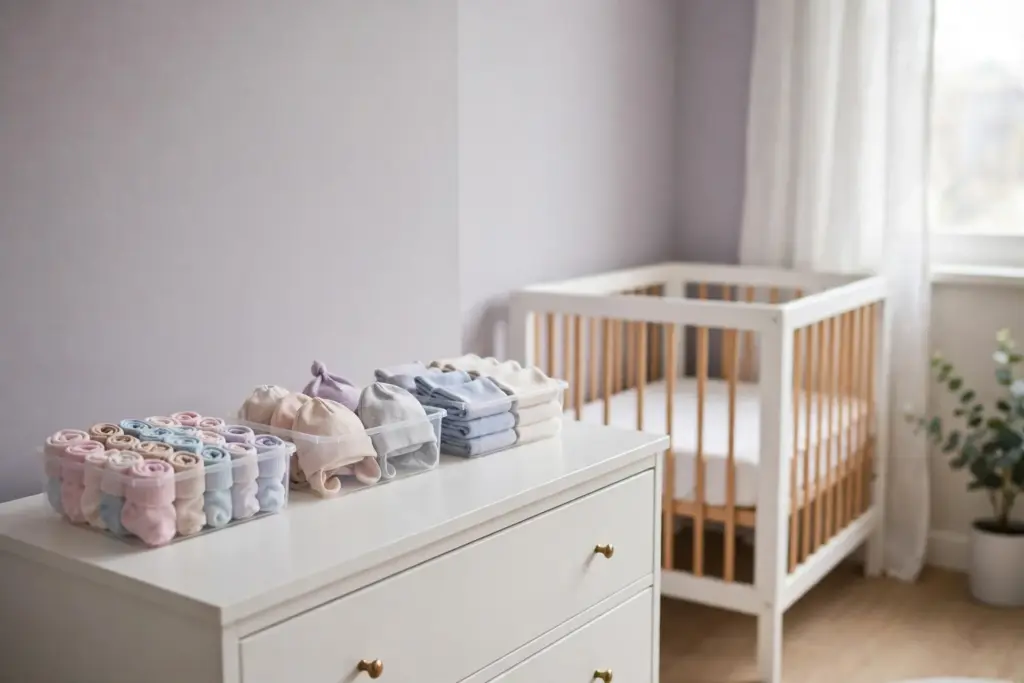
13. Corral socks, hats, and bibs in small containers
The smallest baby items cause the biggest mess, because a single sock can vanish into any drawer. Give them their own small containers: a clear box or a set of tiny fabric bins inside the top dresser drawer, one container per category — socks in one, hats in another, bibs in a third. Roll socks into pairs before they go in, and keep the containers shallow so nothing stacks more than two layers deep. When every tiny item has a container barely bigger than itself, nothing drifts, and the drawer stays sorted for weeks instead of days.
14. Run a 10-minute size check every few weeks
No system survives a growth spurt without maintenance, so put a 10-minute size check on the calendar every two to three weeks. Pull out the current-size drawer, hold each piece up against the next size, and move anything snug into the “too small” bin. Refill the staged next-size bin, check the labels, and put one thing back where it belongs. Done regularly, it is the difference between a closet that stays organized for months and one that collapses back into a pile.
When there is no nursery closet at all
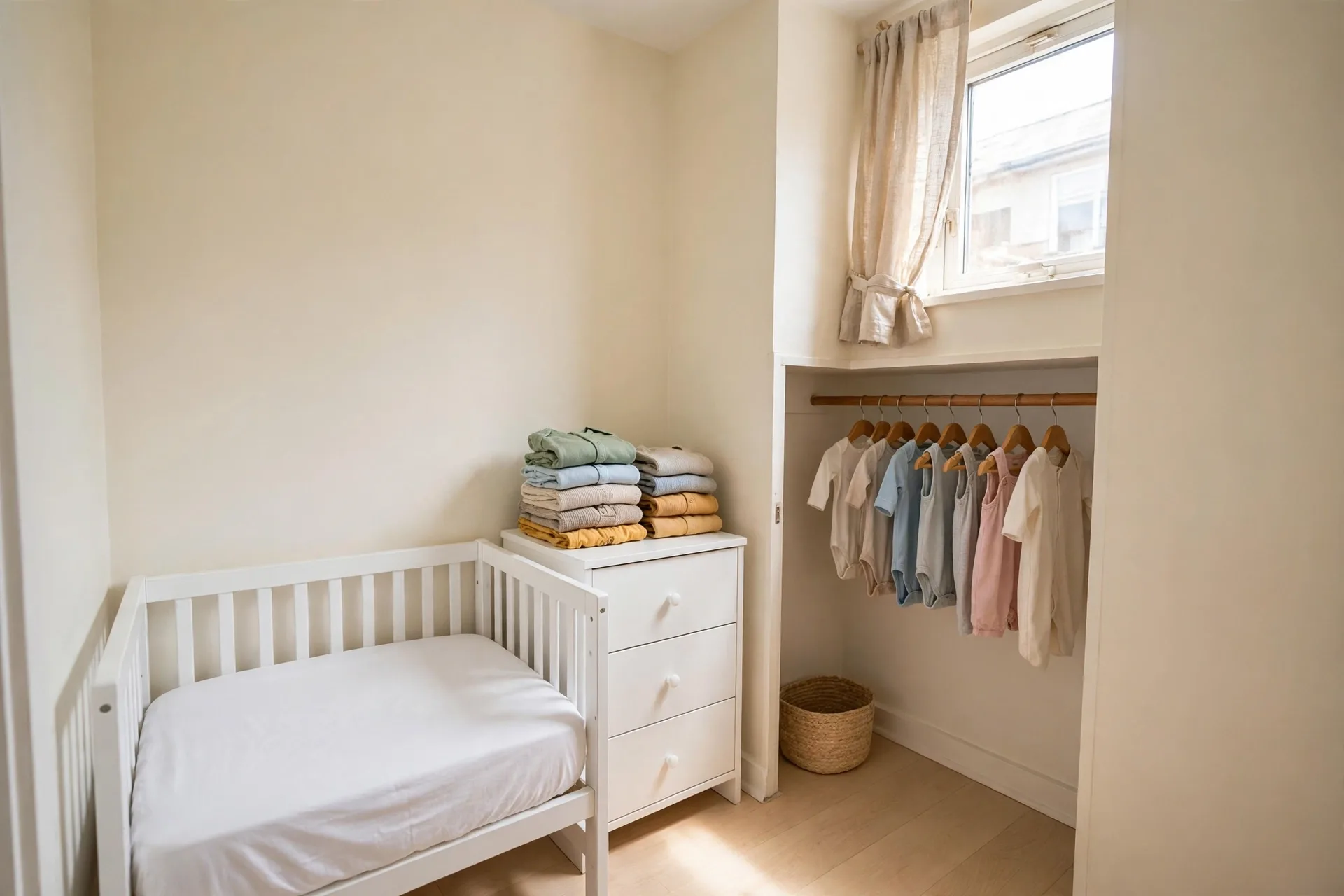
Some rentals have no nursery closet, or the only closet belongs to the adults. These baby clothes organization ideas still work without one: a small dresser plus a rolling cart covers daily clothes, a freestanding garment rack with a fabric cover stands in for the closet rod, and the space under the crib and under the bed takes the rotation bins. The principle does not change — current size within reach, next size staged, everything else labeled and out of the way. For the full room setup, see our small space nursery ideas.
Frequently Asked Questions (FAQ)
How do I organize baby clothes in a small apartment with no nursery?
Start with a dresser and a rolling cart for daily clothes, add a freestanding garment rack for hanging pieces, and use under-crib bins for the next size up. These baby clothes organization ideas are built for rentals: tension rods, over-door organizers, and fabric bins need no drilling and leave no marks,
How often should I sort baby clothes by size?
Every two to three weeks is enough for most babies in the first year, since sizes change every four to eight weeks. A quick 10-minute check — move snug pieces to the “too small” bin, top up the next-size bin, and refresh the labels — keeps the system honest without a full re-sort.
What is the best way to store outgrown baby clothes?
Wash them first, fold them flat, and store them in a labeled, sealed bin by size range — for example, “Outgrown 0–6 Months.” Keep it on a high shelf or under the bed, with only one active “too small” bin in the closet at a time.
Is it safe to store baby clothes under the crib?
Yes, storing folded clothes in bins under the crib is fine — the safety rule is about what goes inside the crib, not underneath it. The crib itself should stay bare with only a fitted sheet, as the U.S. Consumer Product Safety Commission and the National Institutes of Health Safe to Sleep campaign recommend.
Keep Reading
If this guide helped, these three are the natural next step: Small Space Nursery Ideas for Apartments for the full room setup, Kid Closet Organization Ideas for Small Apartments for the system that follows this one, and Toy Storage Ideas for Small Apartments That Clear the Floor Fast for the next thing that will take over the floor.