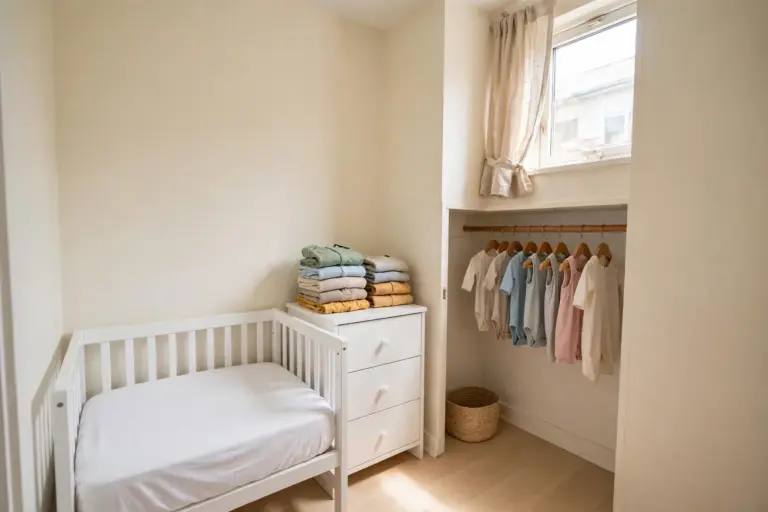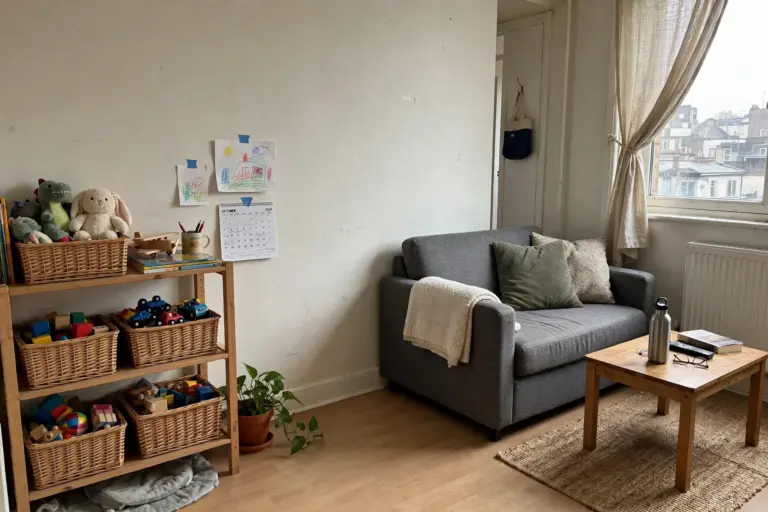
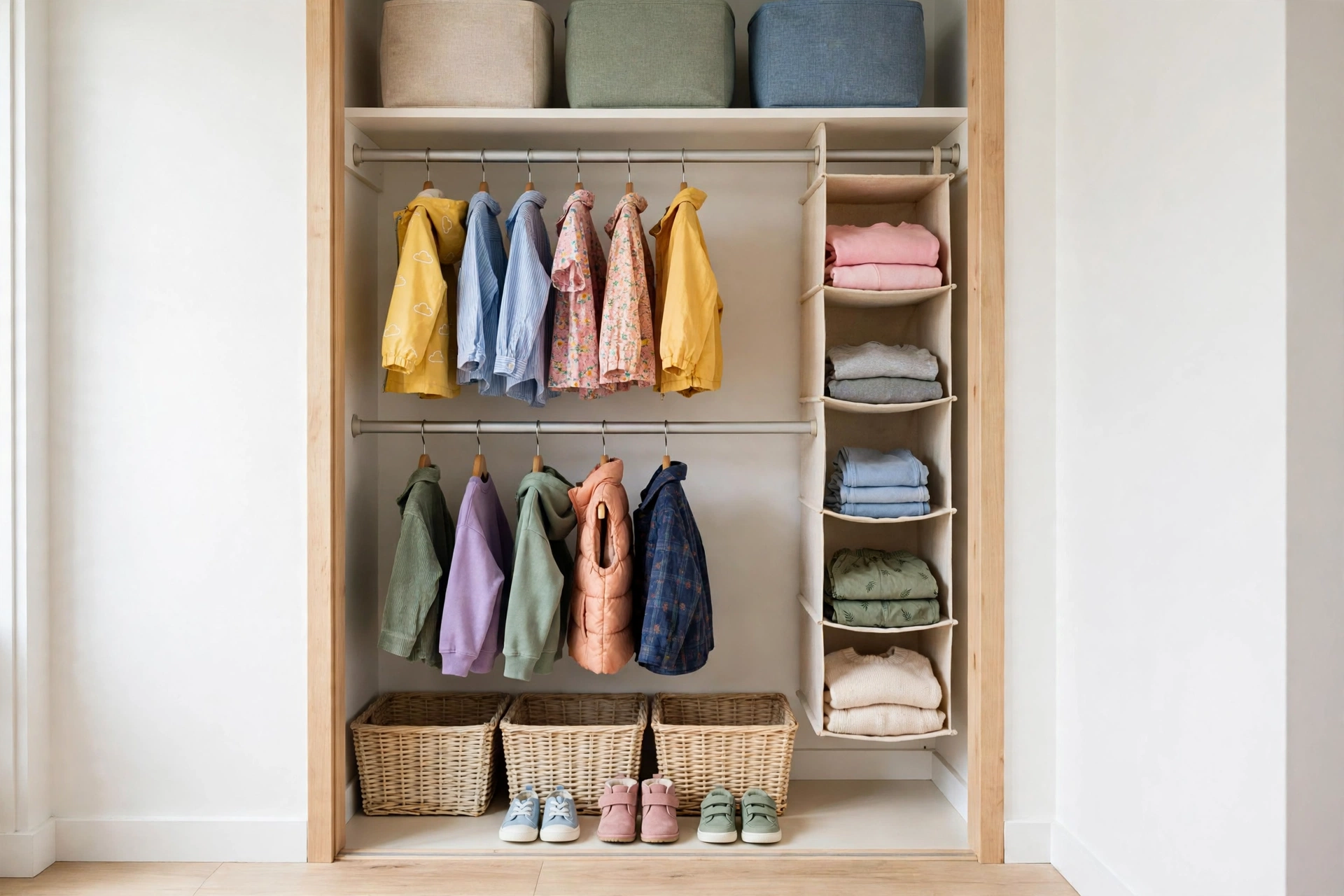
Kid Closet Organization Ideas for Small Apartments
A kid’s closet in a small apartment has a hard job: clothes that change size every few months, shoes, school gear, and the occasional toy overflow — all in a space often only four to six feet wide. These kid closet organization ideas are built for exactly that reality, and every one is renter-safe: no drilling, no built-ins, nothing a landlord would object to at move-out.
Most kids’ closets come with a single rod hung at adult height and one high shelf. That wastes the lower half of the closet and puts everything out of a child’s reach, so clothes end up on the floor. The fix is not a bigger closet — it is a system a child can actually use: clothes at their height, one clear home for every category, and labels they can recognize before they can read words.
12 Kid Closet Organization Ideas for Small Apartments
Each idea works on its own, but they stack well — start with the one that fixes your biggest morning problem.
1. Add a Second, Lower Rod They Can Actually Reach
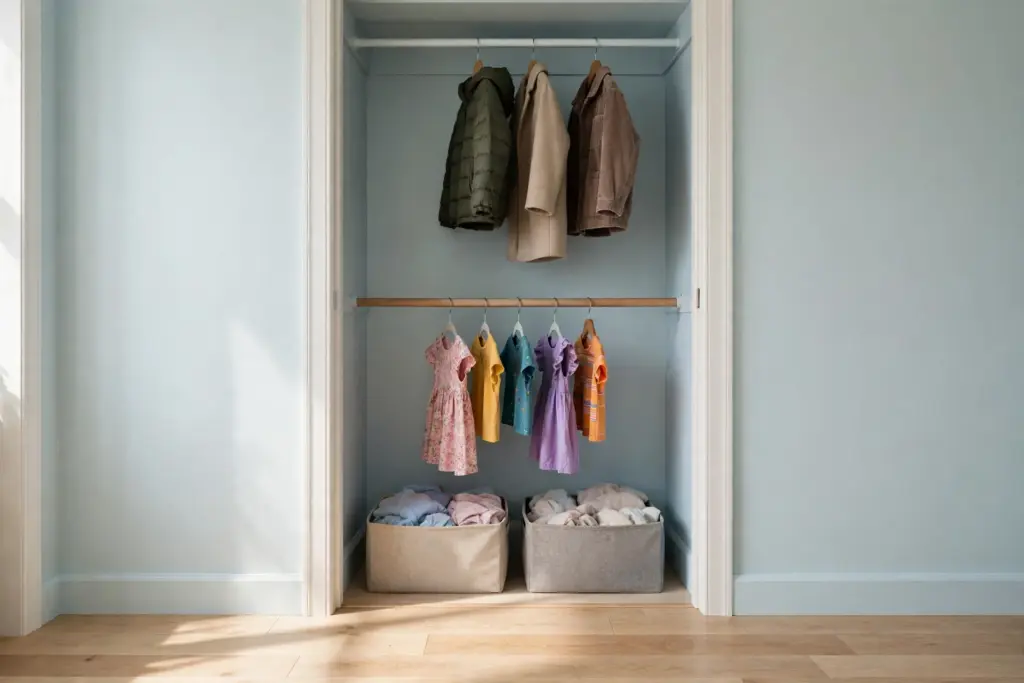
A second rod at child height puts the closet’s lower half to work.
The most useful change in a small kid’s closet is a second rod at child height. Many guides suggest about 28 to 32 inches for toddlers and preschoolers, and 36 to 40 inches for early school-age children — low enough for a child to hang up their own clothes without help. A tension rod or a hook-over doubler rod that hangs from the existing rod needs no screws, no drilling, and no landlord permission, and it comes down cleanly when you move.
Put everyday clothes on the low rod and keep the original high rod for out-of-season items and dress clothes. Short kids’ clothes leave plenty of space below the low rod for bins or shoes.
2. Hang a Fabric Organizer for Folded Clothes
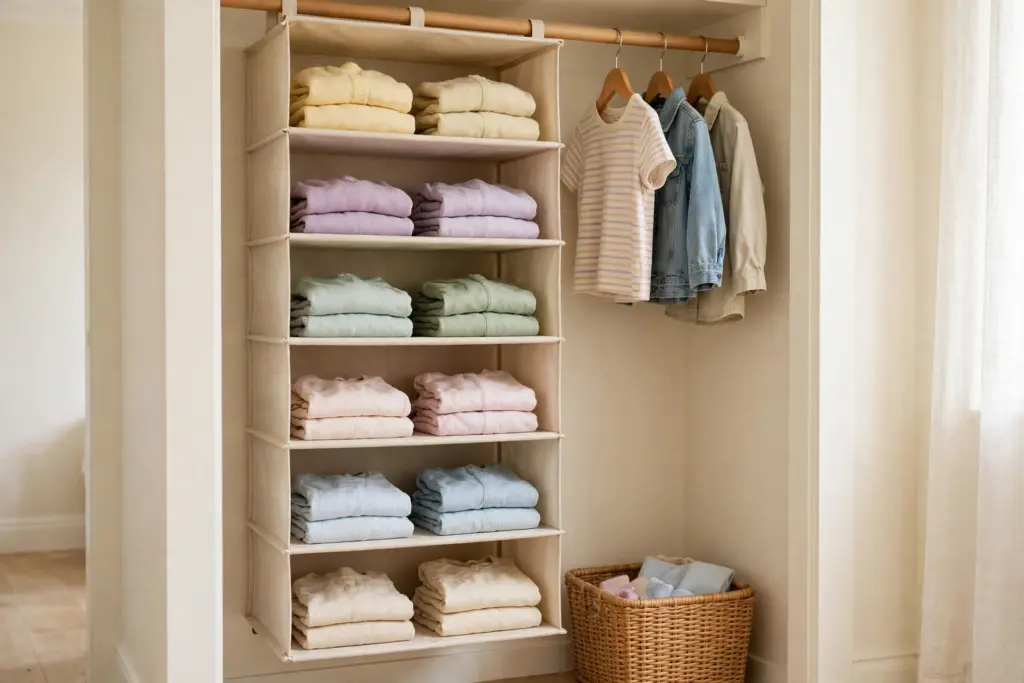
A hanging organizer adds shelves — no tools required.
A hanging fabric organizer over the existing rod instantly adds five or six shelves. Give each shelf one job: pajamas, school clothes, sports gear, weekend outfits. Folded clothes stay visible and reachable — a child will not dig through a deep drawer to find a shirt.
Choose one with stiff shelves, and keep it to one unit per closet — two side by side crowd out the hanging space.
3. Put Open Bins at Floor Level With Picture Labels
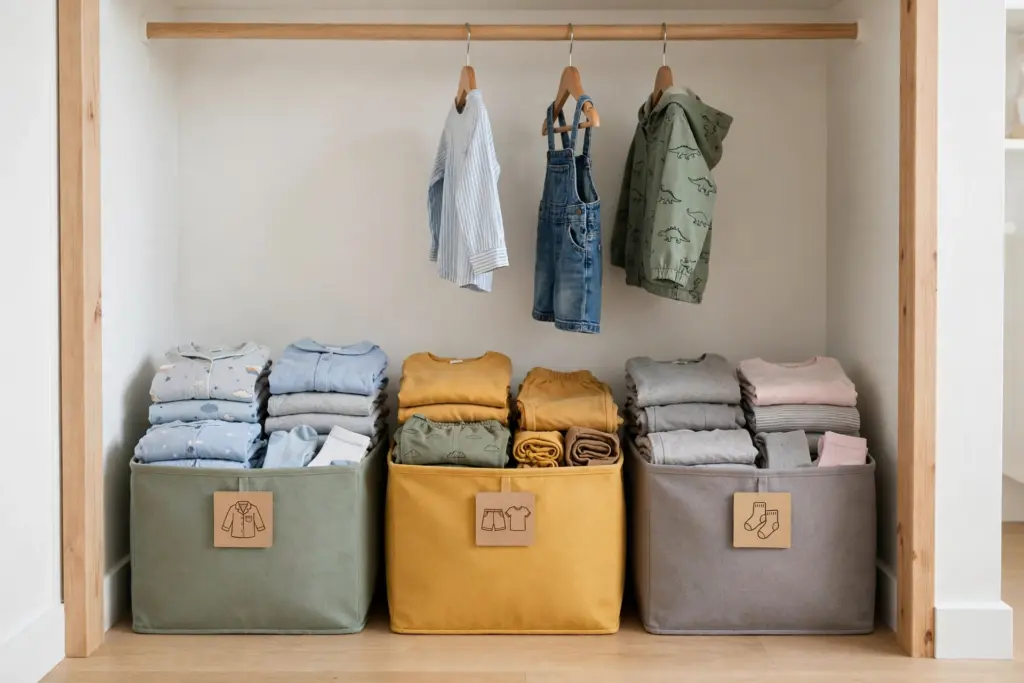
Floor-level bins let small hands grab and return their own clothes.
Two or three open bins on the closet floor hold the everyday basics: pajamas, play clothes, underwear, and socks. Open tops beat lids — a lid is one more step between a child and putting something away. Keep bins shallow and light for a child to pull out and slide back.
Label each bin with a picture plus the word — a simple picture of a shirt next to the word “shirts” helps pre-readers sort correctly and gives early readers practice. Labels remove the guessing, which is what keeps the system working after the first week.
4. Give Every Bin One Category Only
Mixing tops, pants, and pajamas in one big bin turns every morning into a dig. One category per bin is the rule that makes the whole closet work: shirts in one, pants in another, pajamas in a third. When a bin holds one kind of thing, a child finds it in seconds and puts it back.
If a category is small, use a smaller bin rather than merging categories — a half-empty bin with one job beats a full bin with three. The same rule works for adult closets too — see these small apartment closet organization ideas.
5. Trade Bulky Hangers for Slim Velvet Ones
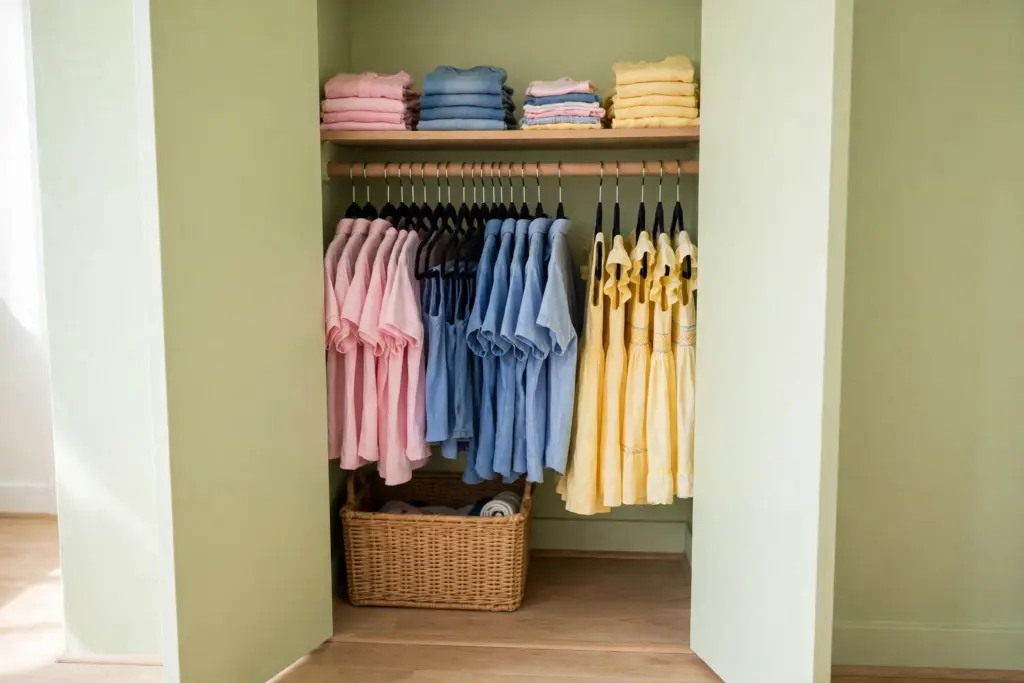
Slim hangers free up rod space in a narrow closet.
Standard plastic hangers are thick, and in a four-foot closet that thickness adds up fast. Slim velvet hangers take roughly half the rod space — and the velvet grip stops small clothes sliding onto the floor.
Hang similar items together and group by color within each category: short sleeves together, then long sleeves, then dresses or pants. A child who cannot read labels yet can still find the blue shirts.
6. Add Low Hooks for Backpacks, Coats, and Dress-Up
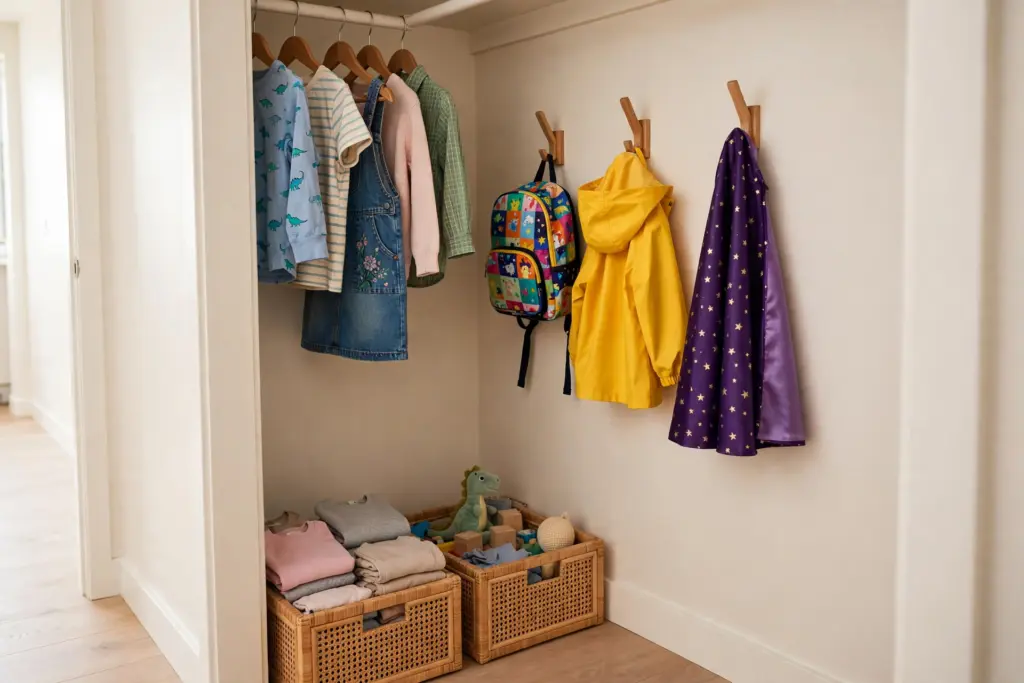
A child-height hook is where the backpack lands, not the floor.
Some things never belong on a hanger: the backpack, the morning coat, the dress-up costume, the favorite hoodie. Hooks at child height — removable adhesive hooks or a freestanding rail — give each a home that takes one second to use.
Keep it to three or four hooks — ten becomes a dumping ground. Put them on the closet’s side wall or the back of the door so they never block the hanging clothes.
7. Use the Door for Accessories With a Pocket Organizer
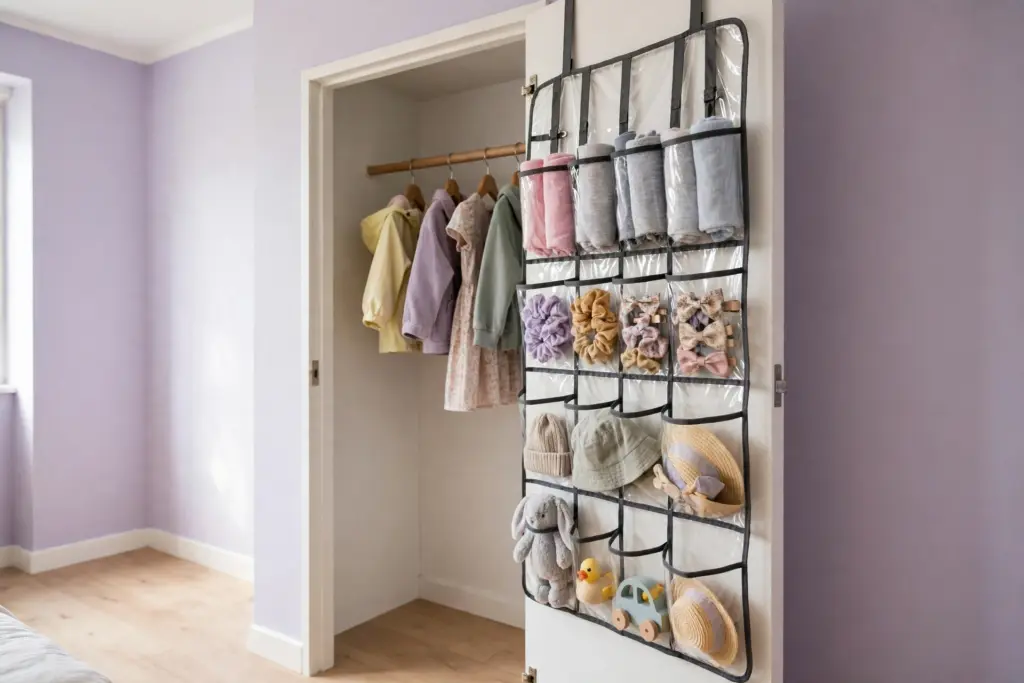
The closet door holds the small stuff that vanishes into drawers.
The back of the closet door is free storage most small apartments never use. A clear over-the-door pocket organizer holds the small things that disappear: socks, hair accessories, hats, gloves, rolled-up T-shirts, small toys. Clear pockets matter — a child sees inside without emptying pockets to find one sock.
Use only the pockets your child can reach, and leave the top rows for items you manage. Check the door still opens freely with the organizer on — if it drags or catches, choose a shorter one.
8. Set Up a Five-Outfit Row for the School Week
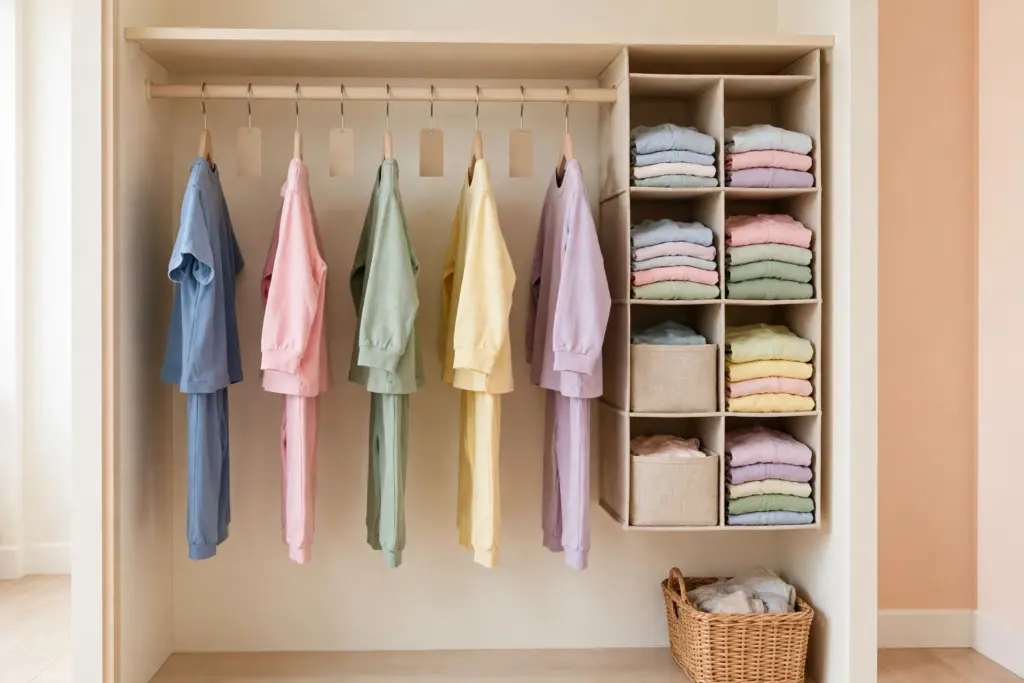
Five hangers, five school days, chosen once on Sunday.
Morning chaos usually starts with choosing clothes, and other guides on kids’ closet organization ideas for easier mornings start from the same place: fix the part that causes trouble first. A five-outfit row does that: five hangers or cubbies, one per school day, filled once on Sunday in fifteen minutes. Day tags let a child pick “Tuesday” without asking.
Let your child help choose the outfits during the Sunday setup — a child who picked their own clothes is far more likely to wear them without a morning debate.
9. Store the Next Size Up on the Top Shelf
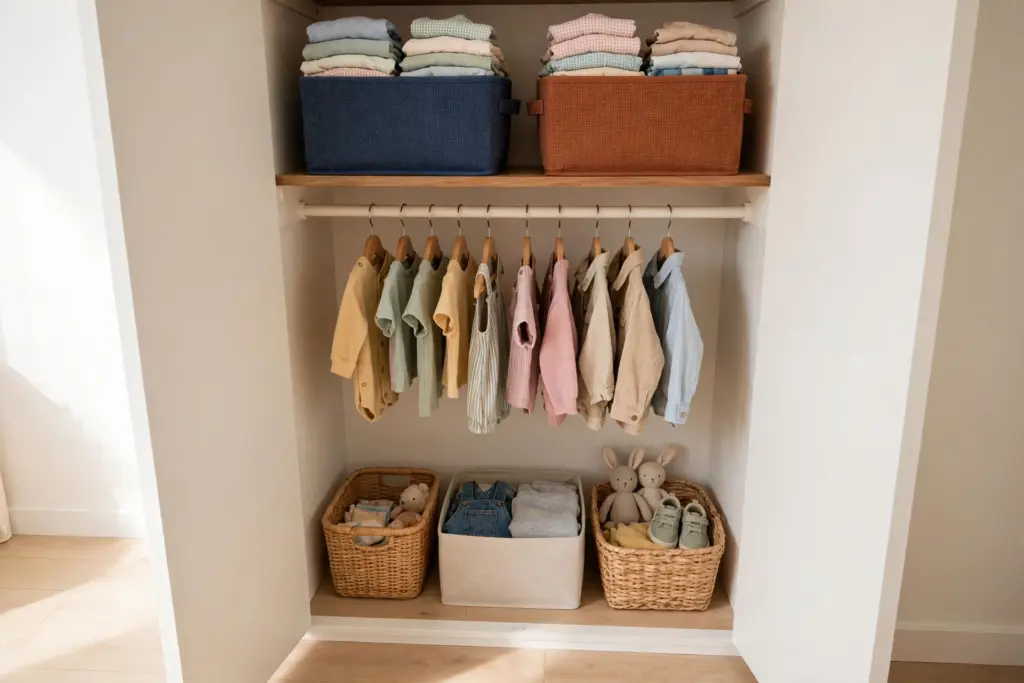
Next-size clothes wait in labeled top bins until the growth spurt.
Kids outgrow clothes faster than any system can keep up with, so the next size up needs a home apart from what fits now. One or two top-shelf bins, labeled by size — “5T” or “Size 7” — hold the next size up, so the swap takes minutes.
Keep a small outgrown box in the closet too, about shoe-box size. The moment a shirt feels tight, it goes in the box instead of back on the rod; when the box fills, it goes straight to donation.
10. Limit Shoes to One Low Row of Three or Four Pairs
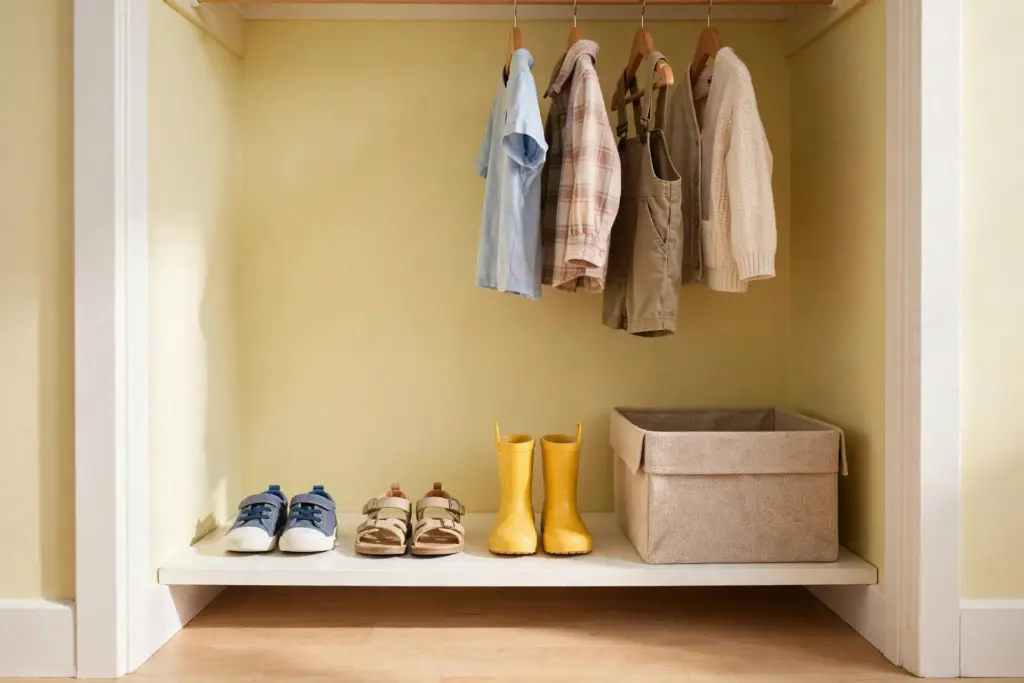
Three or four pairs in one low row; the rest live elsewhere.
Shoes multiply fast, and a pile on the floor is where organization goes to die. Limit the closet to one low row of the three or four pairs in regular use: everyday shoes, school shoes, one spare pair. A low shelf, a tray, or a marked stretch of floor works — the point is the limit, not the container.
Everything else — boots, dress shoes, outgrown pairs — belongs in a labeled bin on the top shelf or another room. A small closet cannot hold a shoe collection and a wardrobe at the same time.
11. Keep One Empty Growth Cube on Purpose
A closet with every cube filled has nowhere to go when life changes. Reserve one shelf or cube, roughly a foot square, with nothing in it. That empty space absorbs the next change without a reorganization project.
It is also a simple test: if the growth cube fills within a month, something else in the closet is overstuffed and needs to leave. Treat the empty cube as a rule, not a suggestion.
12. Cap the Wardrobe So the System Can Survive It
The best closet system fails if the wardrobe keeps growing past what the closet can hold. A simple cap — a set number of everyday outfits that fit the low rod and bins, everything beyond that stored elsewhere — keeps the closet at a size a child can maintain. When something new comes in, something old goes out.
This idea protects all eleven before it: a closet that holds only what fits is a closet a child can keep tidy. For the toys competing for the same small space, these toy storage ideas for small apartments use the same one-home-per-category thinking.
A Renter-Safe Setup That Takes One Afternoon
Put these kid closet organization ideas into practice in this order: empty the closet and remove everything that does not fit now, add the second rod and hanging organizer, place and label the floor bins, then hang clothes back by category with the five-outfit row at the front. Most small closets take an afternoon, and nothing needs a drill or a landlord’s signature.
Before adding freestanding furniture — a small bookcase or cube unit, for example — check the manufacturer’s instructions for its anti-tip hardware. The U.S. Consumer Product Safety Commission’s Anchor It! guidance recommends securing dressers, bookcases, and other furniture children can climb, Renters should check their lease before drilling any anchor into a wall; if drilling is not allowed, choose low, wide, stable units and keep heavier bins on the lowest shelves.
What to Avoid in a Small Kid’s Closet
A few mistakes undo even a good system: deep drawers a child cannot see into, lidded boxes for daily items, anything heavy hung above a child’s head, and a closet so full that pulling one shirt out collapses the row. Above all, avoid systems only an adult can maintain — if a child cannot reach it, read it, or return it in under a minute, it will not stay organized.
The goal is a closet a child can run themselves: clothes at their height, one labeled home per category, a wardrobe that fits the space. Mornings get shorter, and the closet stays that way without a weekly rescue mission. These small bedroom storage ideas extend the same thinking beyond the closet door, for the rest of a small kid’s room.
Kid Closet Organization FAQs
How do I organize a small kids closet with no built-in shelves?
Start with a hanging fabric organizer over the existing rod — five or six shelves, no tools — then add a second lower rod and open bins at floor level. Those three no-drill additions create hanging, shelf, and bin space in a closet that started with one rod and one shelf.
What is the best height for a kids closet rod?
Many guides suggest about 28 to 32 inches for toddlers and preschoolers, and 36 to 40 inches for early school-age children. The right height is the one where your child can slide a hanger on and off without standing on anything — measure your child, not the closet.
How can I organize a kids closet in a rental without drilling?
Use tension rods, hook-over doubler rods, hanging fabric organizers, removable adhesive hooks, and freestanding bins. Every idea in this guide is removable, and most come down in minutes at move-out with no wall damage.
How often should I clean out a kids closet?
A light review every six months fits most growth patterns, with a quick size check at each season change. Keep a small outgrown box inside the closet so too-small clothes leave the rotation when noticed.
How do I get my child to keep their closet organized?
Make the system usable by the child: clothes at their height, one category per labeled bin, picture labels for pre-readers, and a five-outfit row so mornings need no decisions. A system a child can use without help is one they will keep using.