Corner Kitchen Cabinet Organization Ideas
Every small kitchen has one: the corner cabinet where pots go in and never come back out. It is deep, dark, and shaped like a puzzle, so it quietly becomes the place where baking pans, spare lids, and gadgets go to disappear. Good corner kitchen cabinet organization ideas are not about buying the fanciest pull-out on the market. They are about giving that awkward space one clear job, choosing organizers that fit the cabinet you actually have, and keeping what you use most within easy reach. The ten ideas below are renter-friendly — most need no drilling or screws.
First, Know Your Corner Cabinet Type
Before buying a single organizer, open the cabinet and figure out which of the three common types you have. A blind corner has one door on one side, with storage stretching deep behind the neighboring cabinet — the hardest type to reach into, and the one that benefits most from a pull-out. A diagonal corner has a 45-degree angled front and a wide opening, so you can see more of what is inside. An L-shaped corner has folding or double doors that open wide across the whole corner. Each type rewards a different fix, so an organizer that transforms a blind corner can be wasted money in a diagonal one. This quick check also shapes your small apartment kitchen storage plan, because the corner should hold the category that fits it best.
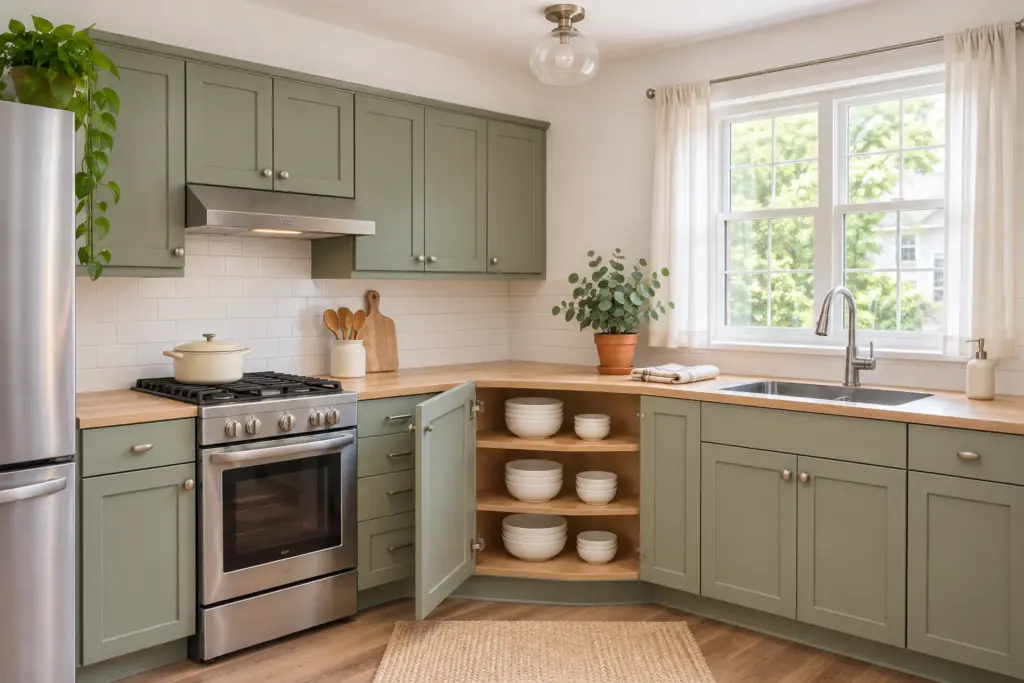
10 Corner Kitchen Cabinet Organization Ideas That Use Every Inch
1. Give the Corner One Job
A corner cabinet fails when it has no job. Without a purpose it becomes the island of misfit gadgets — a slow cooker on top of a waffle maker, next to a stack of mixing bowls that never gets used. Pick one category and commit the whole cabinet to it: baking supplies, everyday cookware, pantry staples, or small appliances. Everything else moves out, even if it has lived there for years. One category means one set of containers, one labeling system, and one mental map of where things live.
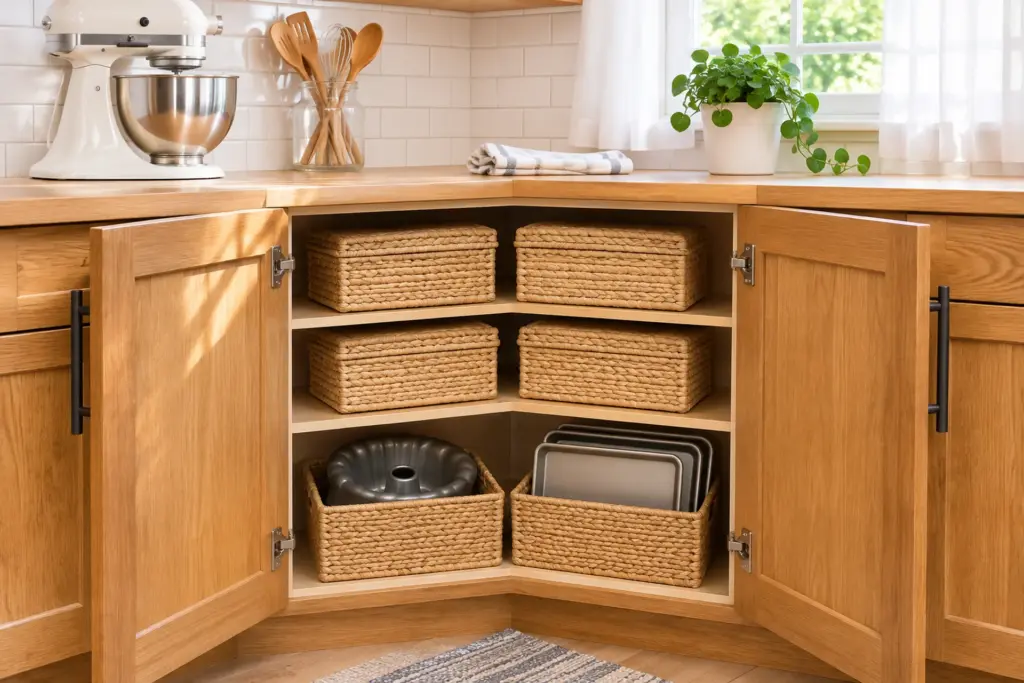
2. Measure Before You Buy Anything
Corner cabinets are full of surprises: shelves that are shallower than they look, hinges that eat two inches of clearance, and door openings narrower than the cabinet itself. Measure the opening width and height, the depth from the door to the back wall, and the height between shelves before ordering anything. Check the manufacturer’s dimensions and load rating for any fitting you are considering, and confirm it matches your cabinet’s size rather than assuming one size fits all.
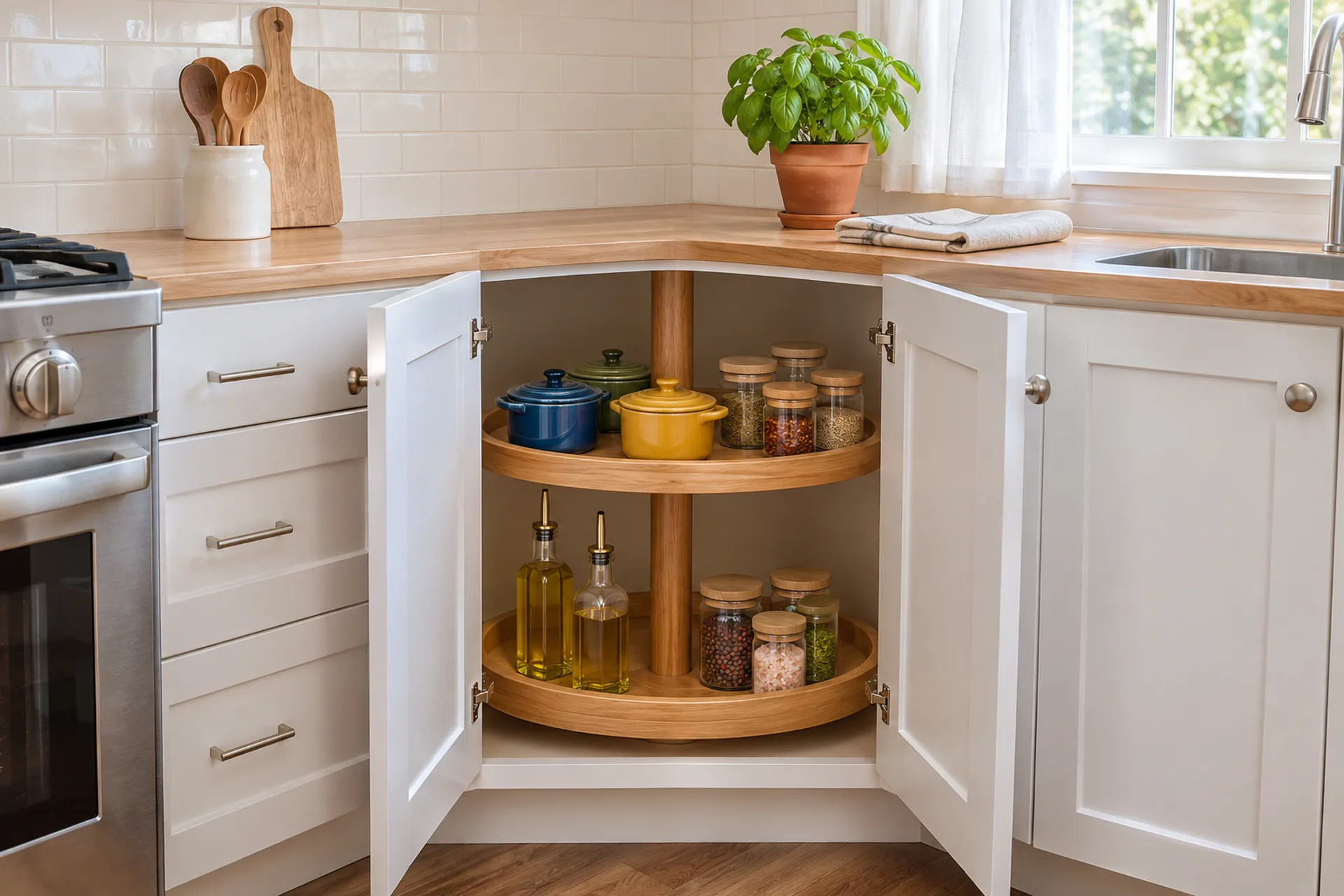
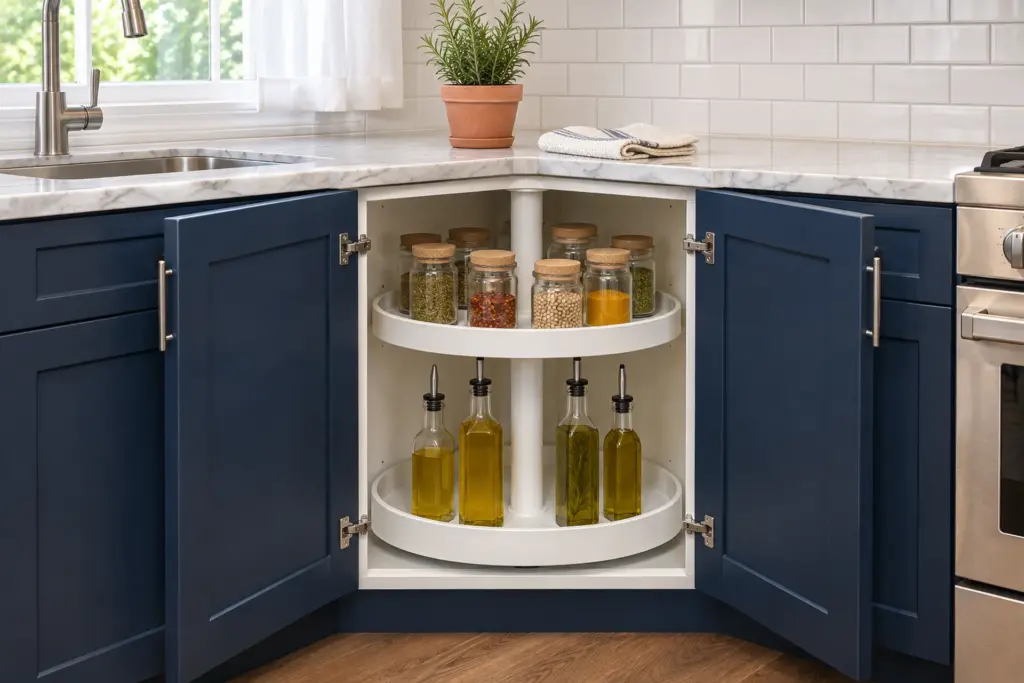
3. Add a Two-Tier Lazy Susan
The lazy Susan is the classic corner fix for a reason: a gentle spin brings the back of the cabinet to you, so nothing gets buried behind something else. A two-tier turntable doubles the usable surface — tall bottles on the bottom tier, where they cannot topple, and shorter jars up top, where you can see them. Add a thin non-slip liner so bottles stay put while the shelf turns. Professional organizers recommend this as one of the first upgrades for a corner cabinet, and The Kitchn’s guide to organizing a corner cabinet puts the lazy Susan at the top of its list for exactly this reason.
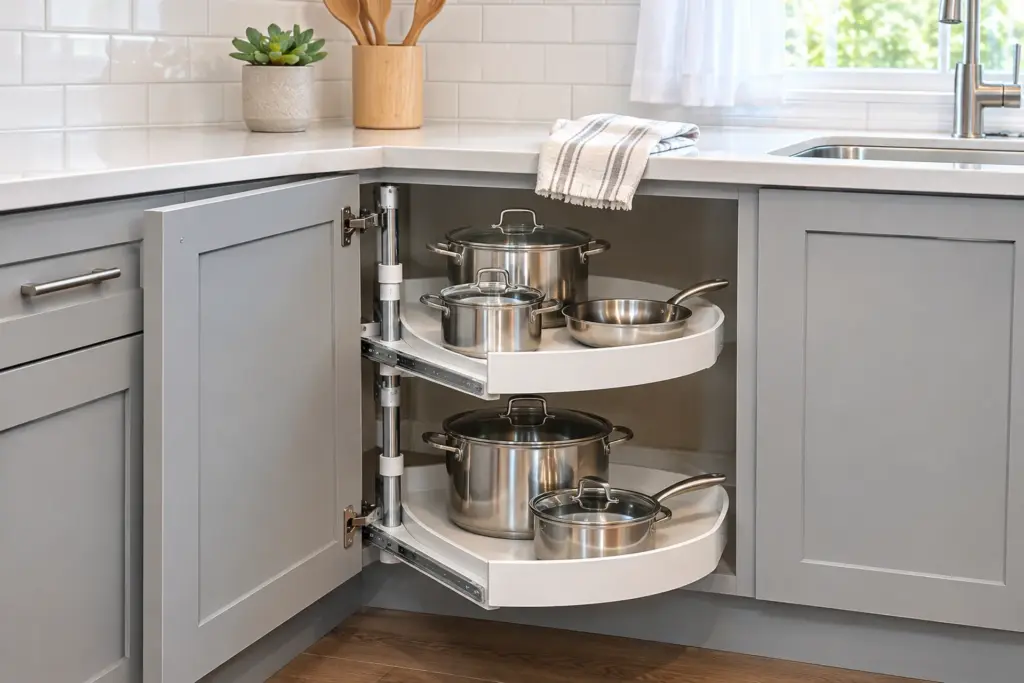
4. Use a Blind-Corner Pull-Out or Swing-Out
If your cabinet is a blind corner, a pull-out or swing-out fitting is the most satisfying fix available. The shelves slide out and pivot toward you, so the deep space behind the neighboring cabinet becomes as reachable as a drawer. These systems are built for heavy things — Dutch ovens, stockpots, and cast-iron pans that are miserable to lift out of a dark corner — and they carry the load on metal runners rather than a spinning shelf. Good corner kitchen cabinet organization ideas for a blind corner usually start here, because no bin or basket can beat a shelf that comes to you. IKEA’s UTRUSTA corner base cabinet pull-out fitting is a widely available example, and the Inspired Kitchen Design spotlight on the UTRUSTA pull-out explains which cabinet sizes it fits — a useful reminder to measure first.
5. Add Slide-Out Shelves and Low Bins
If a full swing-out system is more than your budget or your lease allows, slide-out shelves give you most of the benefit for a fraction of the cost. A shallow tray on full-extension runners turns a deep shelf into a drawer you can pull toward you, and two or three low, wide bins on top of the tray give every shelf a clear purpose. This combination works especially well for pantry staples — pasta, rice, canned goods — because the bins lift out as a unit and carry to the counter like a little basket. It also pairs well with these kitchen counter organization ideas for small kitchens, since a corner that holds the pantry overflow keeps the counters clearer.
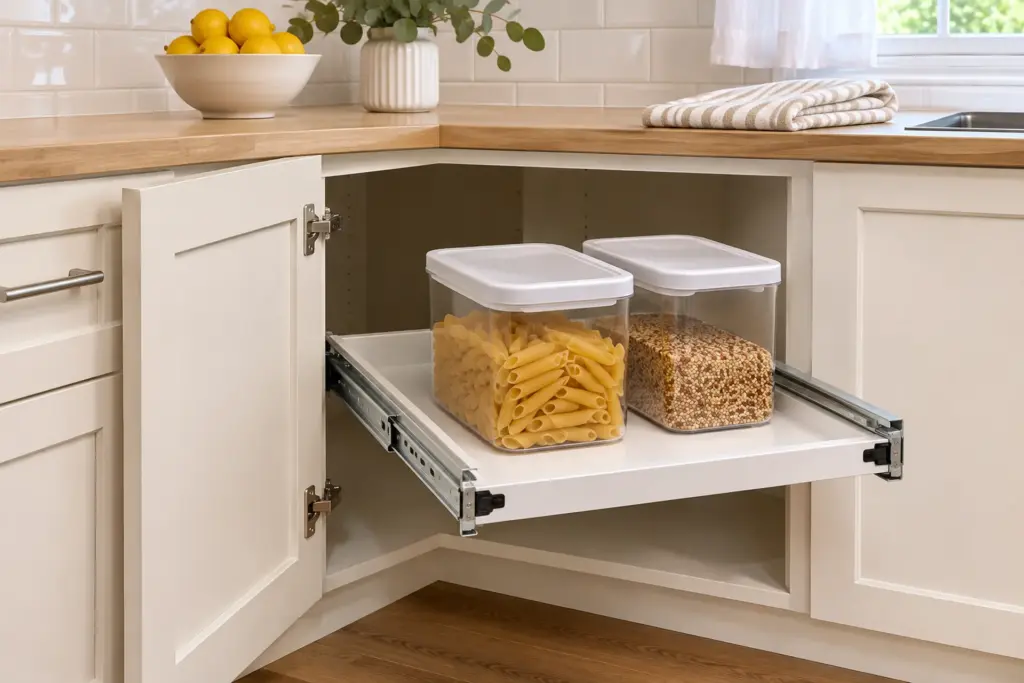
6. Use Clear Stackable Bins — and Label Them
Clear bins are the lowest-cost way to stop a corner cabinet from turning into a pile. Because you can see through them, you never have to pull three containers out to find the one you want, and because they stack, they use the full height between shelves instead of just the floor of the cabinet. Group like with like — baking supplies in one bin, food storage containers in another — and label the front of each bin so everyone in the household puts things back in the same place. Leave the lids in their own bin, standing on edge, rather than stacked on top of the containers they belong to.
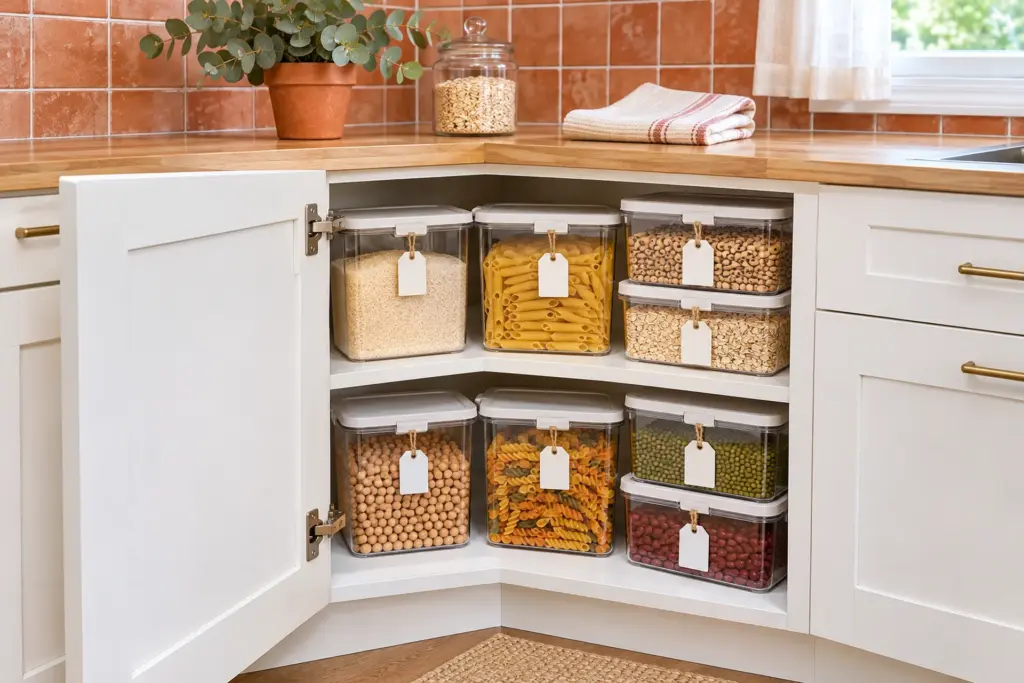
7. Stand Trays, Lids, and Boards on Edge
Flat things are the worst tenants of a corner cabinet. Baking sheets, cutting boards, and pot lids stacked flat slide around, wedge against each other, and force you to lift the whole pile to reach the one at the bottom. Stand them on edge instead, held upright by a vertical divider or a simple tension rod, and each one slides out like a file from a drawer. This works in both base and wall corner cabinets, and it costs almost nothing: a pair of upright dividers, or even a sturdy bookend, creates the slots.
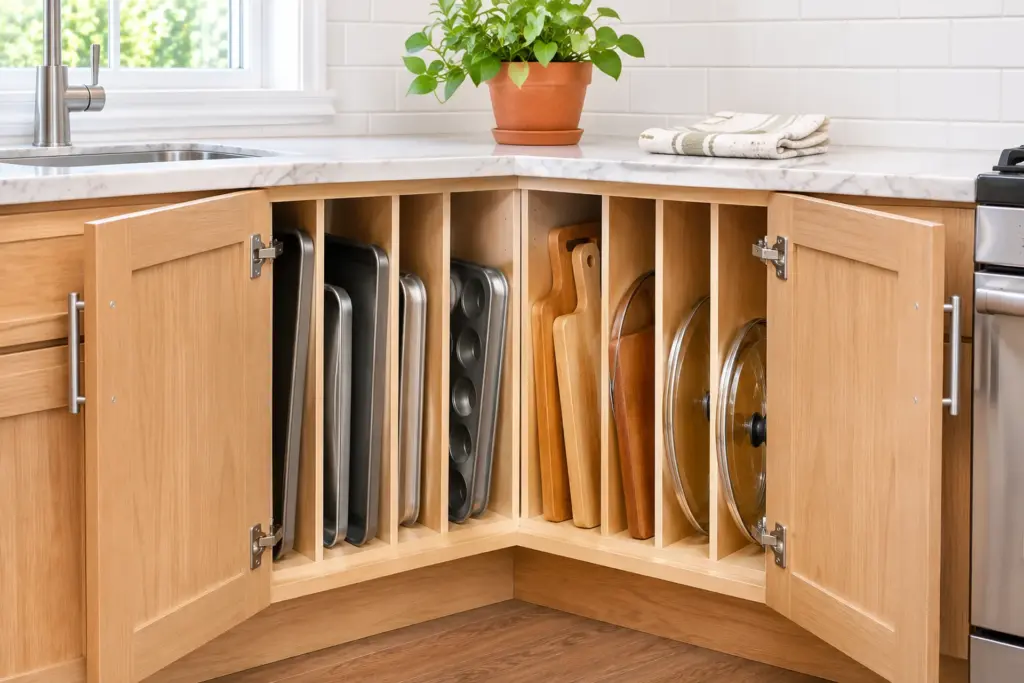
8. Use the Inside of the Door
The inside of the cabinet door is free storage that most kitchens never use. A slim rack mounted there holds spice jars, measuring spoons, or cleaning supplies in the exact spot where they are easiest to grab, and it keeps small things from getting lost behind the big ones. Renters have two lease-safe options: an over-the-door rack that hooks over the top edge, or an adhesive-mounted rack that sticks on and peels off without holes. Either way, check that the rack and its contents clear the shelf and the cabinet frame when the door swings shut — test the swing empty before filling it.
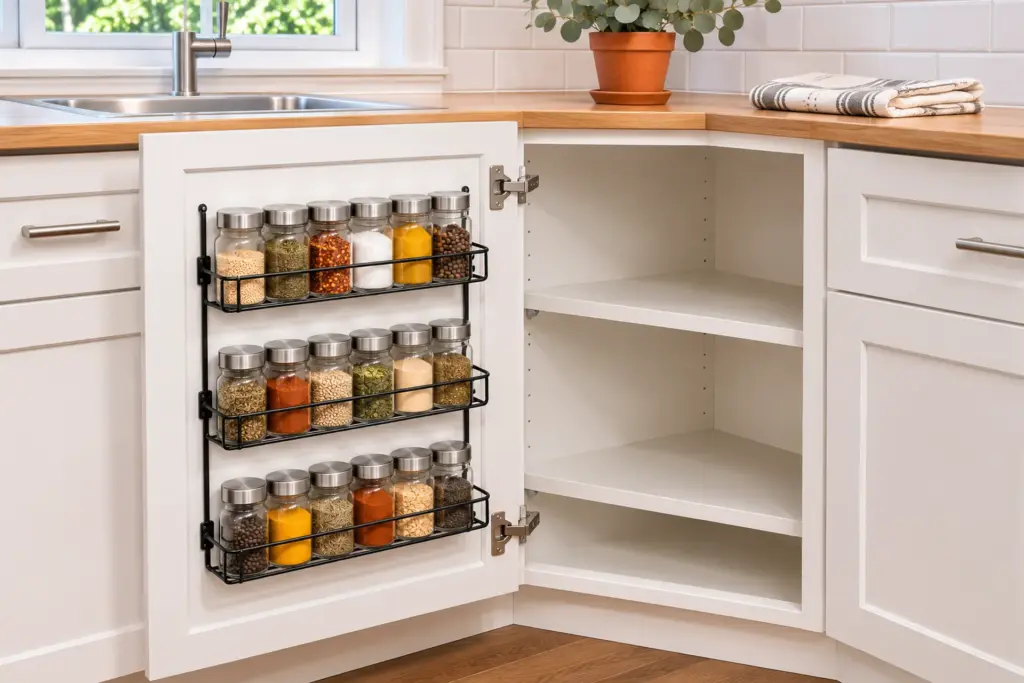
9. Light It Up
A dark corner cabinet hides its own contents, so even a perfectly organized one feels like a black hole. Battery-powered LED puck lights, stuck to the underside of a shelf with adhesive, fix that in minutes with no wiring and no landlord permission needed. Place one light near the front and one toward the back so the beam reaches the deepest part of the cabinet, and choose a warm white tone that matches the rest of the kitchen. Keep the lights clear of any turntable or pull-out mechanism — spin the lazy Susan once after installing them to confirm nothing collides. The same lighting trick helps under the sink; see these under-sink storage ideas for renters for a matching setup.
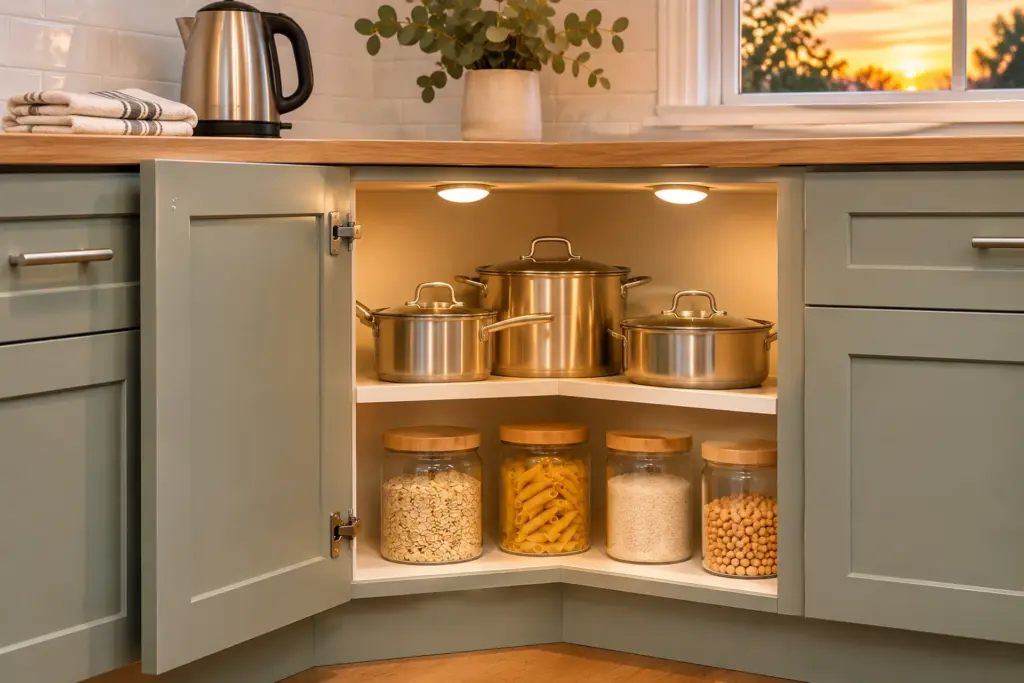
10. Zone by Frequency — the Back Is for Rarely Used
The last idea is a rule, not a product: put daily items at the front, weekly items in the middle, and rarely used items at the back. The pasta pot you use three nights a week belongs within arm’s reach of the door; the turkey roaster that comes out once a year belongs in the deepest part of the blind corner. Most corner cabinets are organized by size or by whatever fit, not by frequency — which is why the daily coffee filters end up behind the fondue set. If the corner still feels crowded after zoning, the honest fix is to store less in it, not to buy a bigger organizer.
What Not to Store in a Corner Cabinet
Some things do not belong in a corner at all. Heavy appliances you use daily — the coffee maker, the toaster — belong on the counter or on an easy shelf, not at the end of a deep reach. Anything fragile and rarely used, like a crystal serving set, is safer on a higher shelf where it is not jostled every time you pull a pot out. Cleaning chemicals should stay out of a food cabinet entirely; they belong under the sink, in their own zone. The corner is at its best holding sturdy, grouped, lidded things that you reach for on a regular schedule. The broader plan for the rest is the small apartment storage ideas guide that anchors this series.
Frequently Asked Questions (FAQ)
What is the best way to organize a corner kitchen cabinet in a rental?
Start with the no-drill fixes: give the cabinet one category, add a freestanding lazy Susan or slide-out tray, and use clear bins with labels. These need no screws and no landlord approval, and they solve most corner problems.
Are lazy Susans or pull-out shelves better for a blind corner cabinet?
Pull-out and swing-out shelves are better for blind corners, because they bring the contents out to you instead of asking you to reach into the dark. A lazy Susan is simpler and cheaper, and it works well in diagonal or L-shaped corners where the opening is wide — but in a true blind corner, part of the turntable stays hard to reach.
How do I organize a corner cabinet without drilling?
Use freestanding organizers: a two-tier turntable, slide-out trays that sit on the shelf, clear stackable bins, vertical dividers, and adhesive or over-the-door racks. Battery puck lights add visibility with no wiring. Avoid anything that screws into the cabinet walls unless the lease allows it.
What should I put in the back of a corner cabinet?
Put the things you use least often at the back — seasonal cookware, a turkey roaster, a fondue set, or backup supplies. Keep daily and weekly items at the front. Write down what lives at the back so you remember it is there, and check the list every few months.
How much does a corner cabinet organizer cost?
Costs vary widely by type. A basic turntable or a set of clear bins is a low-cost fix, while a full swing-out system costs several times more and may need professional fitting.
Keep Reading
- 17 Small Apartment Kitchen Storage Ideas for Renters — the full kitchen plan this corner fits into.
- 15 Kitchen Counter Organization Ideas for Small Kitchens — clear the counters once the corner holds its share.
- Kitchen Organization: Spice Storage Ideas for Small Kitchens — where the spice jars from your corner cabinet can live instead.