
13 Seasonal Decor Storage Ideas for Apartments With No Storage Room
The tree is down, the lights are coiled on the floor, and the wreath is leaning against a chair — and the question nobody asked in December is suddenly urgent: where does all of this actually go? These seasonal decor storage ideas for small apartments answer exactly that, for a home with no storage room, no garage, and no spare closet. The test for every idea below is simple: can the whole season be found, in one labelled place, in under five minutes? Treat that as the goal, not a promise for every flat — if an idea fails that test, it does not make the list.
This is the closing piece of the seasonal cluster. Renter-friendly Christmas decor ideas for small apartments covered what to put up, and renter-friendly Christmas lights covered how to hang them without damage. This guide covers where it all lives for the other eleven months — inside the flat itself, using space that already exists. For the wider system these ideas sit inside, the small apartment storage ideas pillar lays out the same one-home logic room by room.
Give Every Season One Labelled Home
Idea one: pick one home for the whole season, and keep it there. Scattered storage is why January decorating turns into a hunt — ornaments in a kitchen cupboard, lights in a bedroom drawer, the wreath balanced on top of a wardrobe. One zone changes that. Depending on the flat, the zone might be one under-bed bin run, one closet top shelf, or one storage ottoman. The size of the zone matters less than its singleness: when everything for a season lives in one place, finding it takes minutes, not an afternoon. The same logic covers Halloween props, autumn garlands, spring wreaths, and Easter table runners — each season gets its own labelled home, not a shared pile.
Idea two: label by category, not by box. A box marked “Christmas” tells you nothing once it is sealed. Labels that name the contents — “Ornaments,” “Lights,” “Wreath,” “Table linens” — do the real work, and a short contents list taped inside the lid helps even more. Label every container on at least two sides, so the right one is visible no matter how the bins end up stacked. 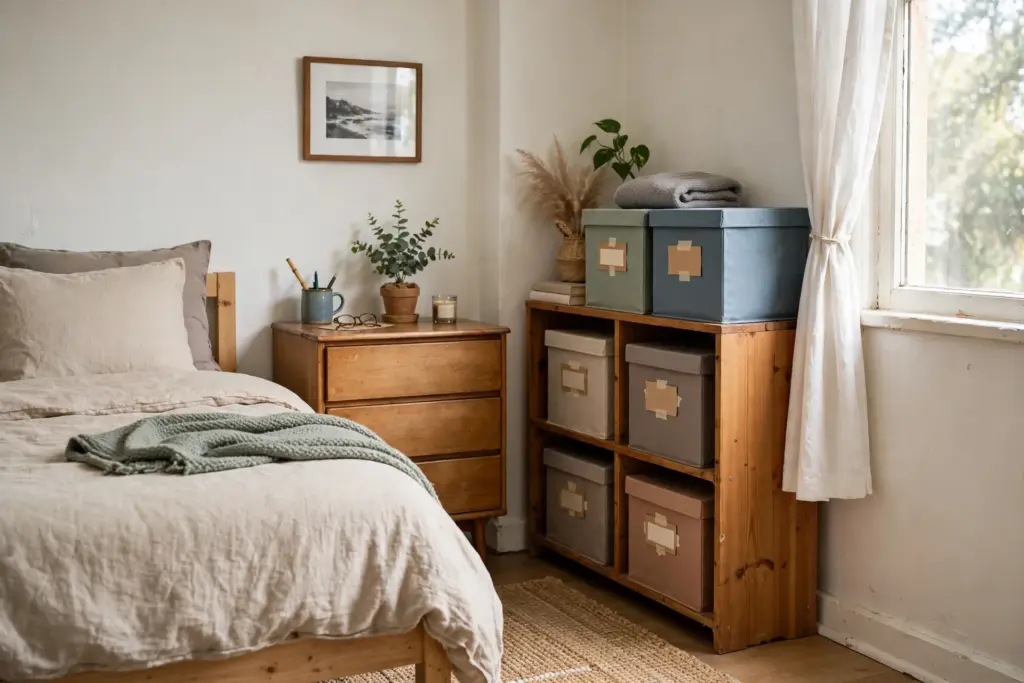
Slide It Under the Bed
Idea three: the space under the bed is the most underused storage in a small flat, and slim rigid bins turn it into a full seasonal zone. Measure the clearance first — bed frames vary — and choose low, lidded bins that slide out without lifting the mattress. Fragile pieces go in divided or padded sections inside the bin, never loose at the bottom where they shift every time the bin moves. Clear bins help here, since the contents stay visible without opening anything, and a bin on small castors or with a pull handle saves the knees. Keep the heaviest bin nearest the edge so it comes out first, and never block a heater vent with a stored bin. 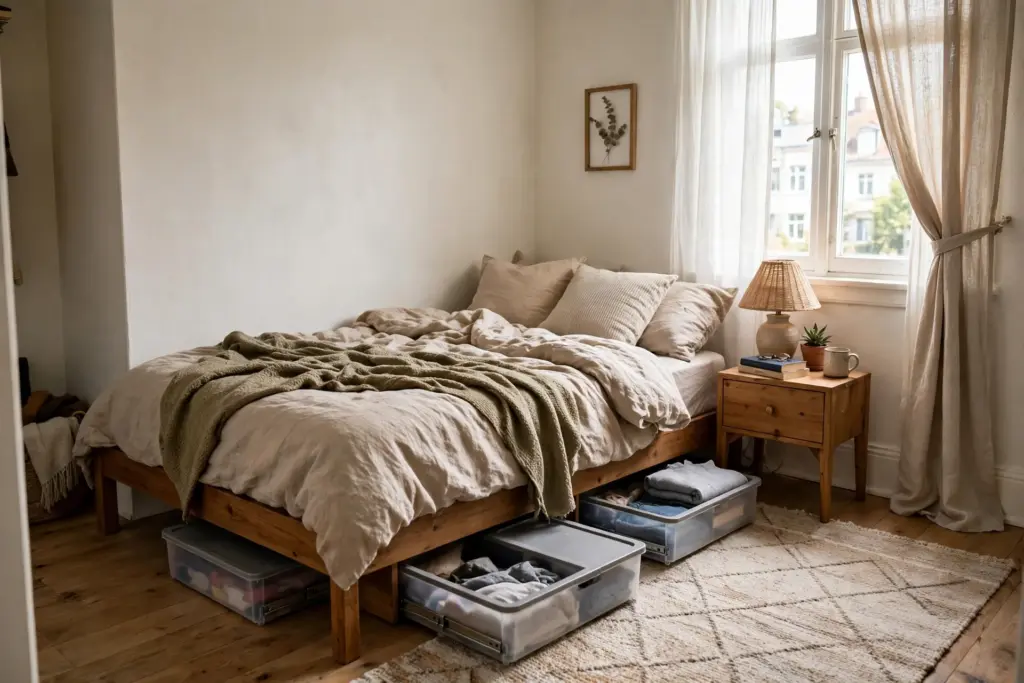
Claim the Closet Top Shelf — Light Items Only
Idea four: the top shelf of a closet is prime seasonal territory, with one firm rule — light items only up high. Garlands, table runners, small fabric pieces, and empty ornament dividers belong there; heavy bins do not. A full bin dropped from head height is a safety problem, and a shelf bowed under weight is a landlord conversation nobody wants. Keep a small step stool nearby rather than climbing furniture, and leave the shelf’s front edge clear so nothing slides off when the door opens. The labelled-basket logic from small linen closet organization ideas works the same way here: one basket per category, labels facing out. 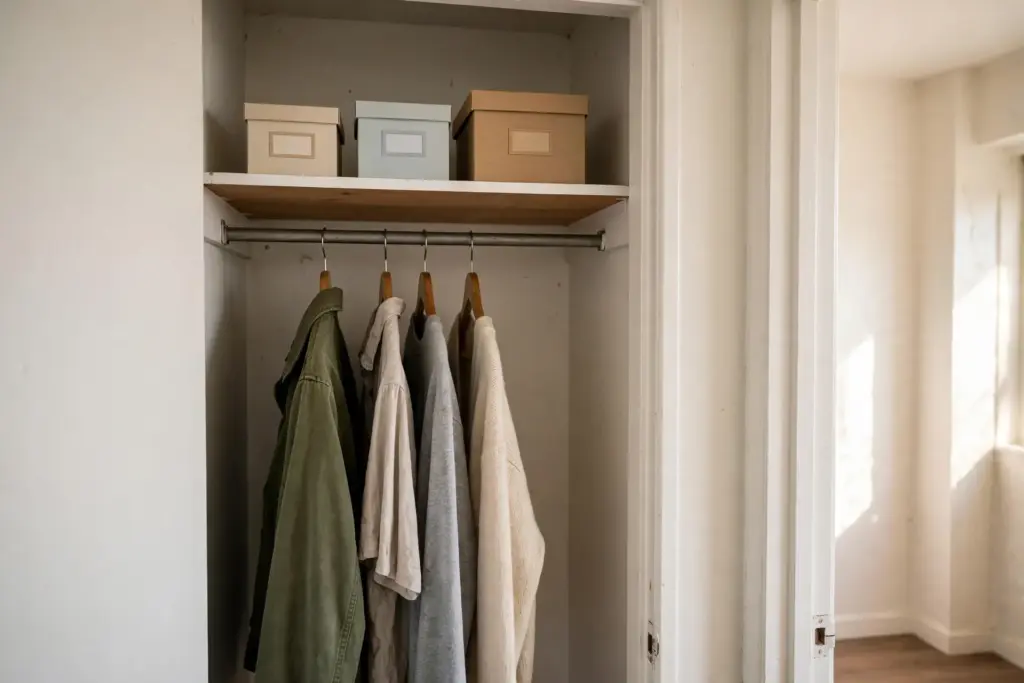
Hide It Inside Furniture You Already Own
Idea five: the best seasonal storage is furniture that earns its floor space twice. A storage ottoman holds a full off-season set — table linens, a garland, small ornaments in a padded pouch — while serving as a coffee table or extra seat the other eleven months. A lidded bench by the window does the same job, and a spare suitcase works as a seasonal case: pack the off-season set inside, slide it under the bed or stand it in the closet, and it costs no new furniture at all. Whatever the piece, the rule from the first section still holds — one season, one home, labelled — so the ottoman never becomes a mystery box. 
Use the Back of a Door
Idea six: the back of a bedroom or closet door is free, vertical, renter-friendly space — an over-door organizer with clear pockets holds exactly the small seasonal bits that otherwise vanish into drawers. Ribbons, gift tags, small ornaments, hooks, and spare clips each get a pocket, visible at a glance. Over-door hooks need no screws, which keeps them firmly in renter territory — but bare metal hooks can scratch paint or dent a soft door edge, so choose padded hooks, check the bracket does not rub when the door closes, and keep the weight modest so the door still closes cleanly, and keep this zone for small, light items only; anything heavy belongs in a bin, low down. 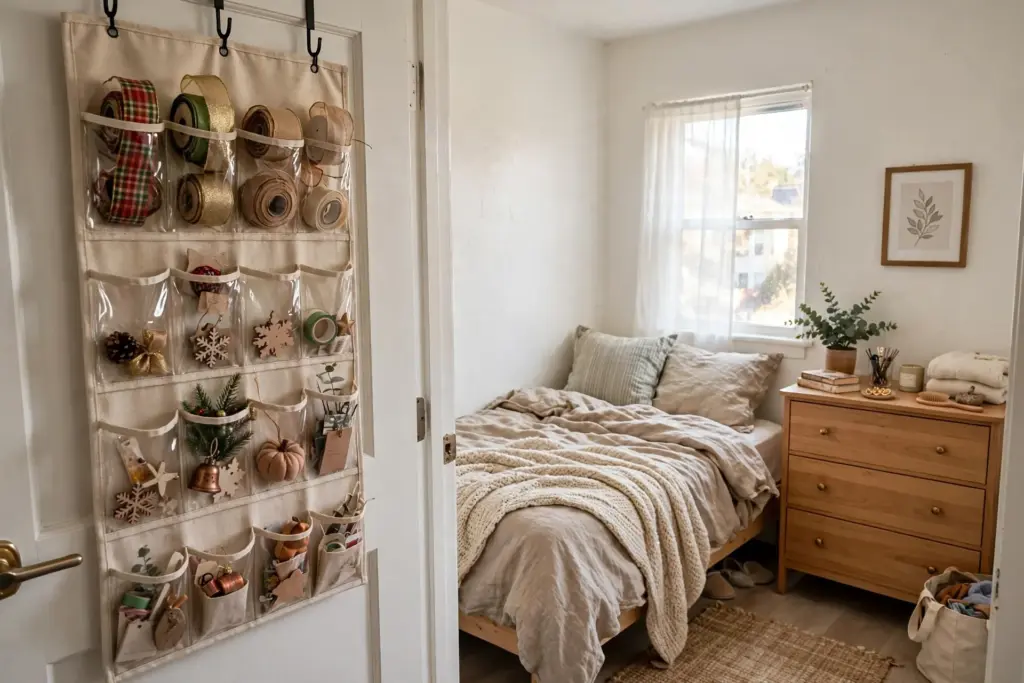
Hang the Wreath, Never Stack On It
Idea seven: a wreath survives storage only if nothing crushes it, and the simplest crush-proof home is a garment bag on a closet rod. Slip the wreath into a clear garment bag, hang it from a hanger on the rod, and it keeps its shape, stays dust-free, and stays visible — no special container to buy, no stack of boxes pressing on it from above. Never put a heavy bin on top of a stored wreath, and never hang it where it will be flattened against a wall by coats. One wreath per bag, hung with space around it, comes out next season looking the way it went in. This is for artificial wreaths only — never store a fresh evergreen wreath sealed in a plastic bag for a year; it will dry out, shed, and can mould. A fresh wreath is for the season, then composted or discarded. 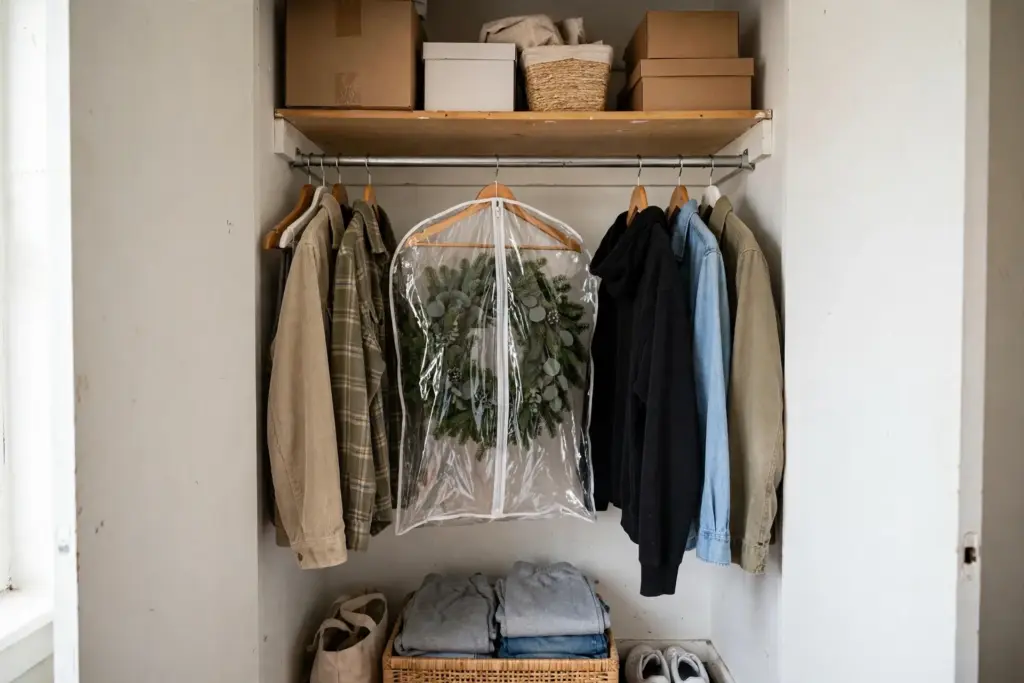
Wind the Lights Before They Tangle
Idea eight: January’s most avoidable frustration is a knotted light strand, and the fix takes two minutes at pack-away time. Wind each strand around a stiff card, a cord reel, or a spare hanger, tape or tuck both ends so the coil cannot unwind, and store the coil flat in the season’s bin with its clips and spare bulbs in a small pouch beside it. Before winding, inspect each strand for frayed cords, cracked sockets, or broken bulbs — a damaged strand gets repaired or discarded, not stored for next year. The lights-storage twin of this guide, renter-friendly Christmas lights, covers which strands suit which spots; the storage rule is the same for all of them. Before packing battery strands, take the batteries out — leaked batteries ruin stored decor and remotes alike — and keep the battery pack with the strand so nothing is hunted for next year. 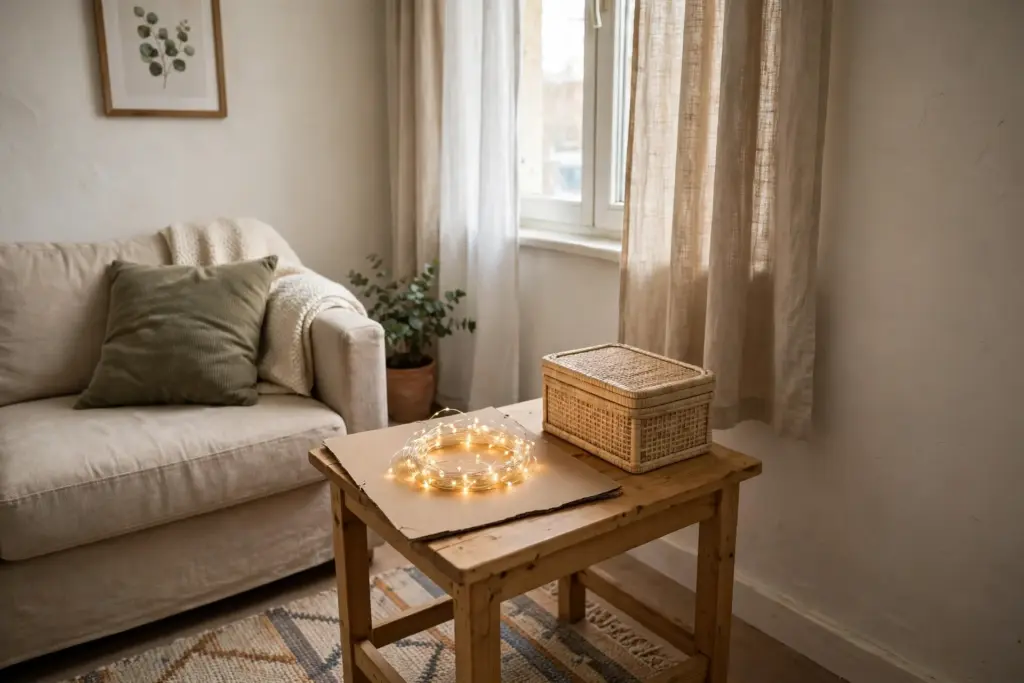
Store the Tree Flat or Upright — Inside the Flat
Idea nine: a small artificial tree does not need a garage; it needs a bag and a flat-or-upright home. Break the tree into its sections, wrap the sections loosely so branches are not bent, and slide them into a long storage bag that fits under the bed or stands upright at the back of a closet. Slim and tabletop trees fit even more easily — a tall bin or the tree’s original box in a closet corner does the job. Skip any plan that involves a ceiling hook, an overhead rack, or a wall fixing: those belong to houses with garages, not rentals, and fixings are permission territory. Keep the bag clear of radiators and out of walkways, and the tree comes out undamaged. 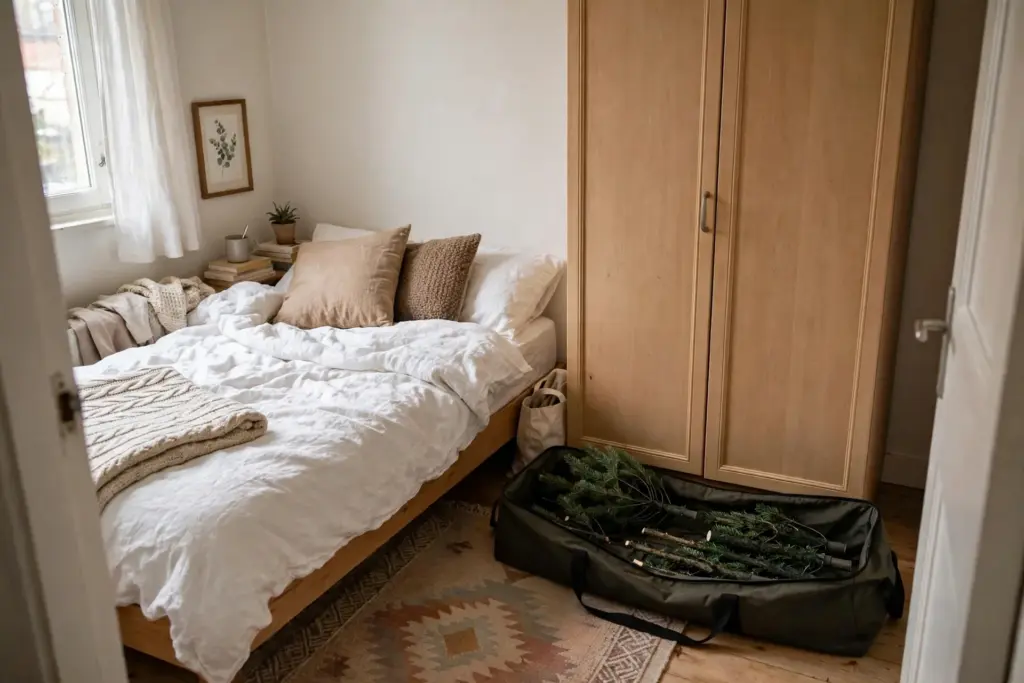
Vacuum-Bag Textiles Only
Idea ten: vacuum bags are brilliant for exactly one category — soft textiles. Table runners, tree skirts, throws, and fabric bunting compress flat and slide into gaps no rigid bin can use. But fragile items must never be vacuum-bagged: ornaments, wreaths, and anything crushable come out damaged, and no saving of space is worth that. The same caution applies to delicate natural fibres, embroidered fabrics, and structured pieces — check the material’s care instructions first, and make sure every textile is fully dry before sealing, or trapped damp will mould. Pack textiles in their own sealed bags, label the bags, and lay them flat inside the season’s bin or under the bed. Keep paper, fabric, and ornaments out of damp spots entirely — under a sink or against a damp bathroom wall is a mould risk, not a storage solution, so flag those spots as poor choices and use a dry closet or under-bed zone instead. 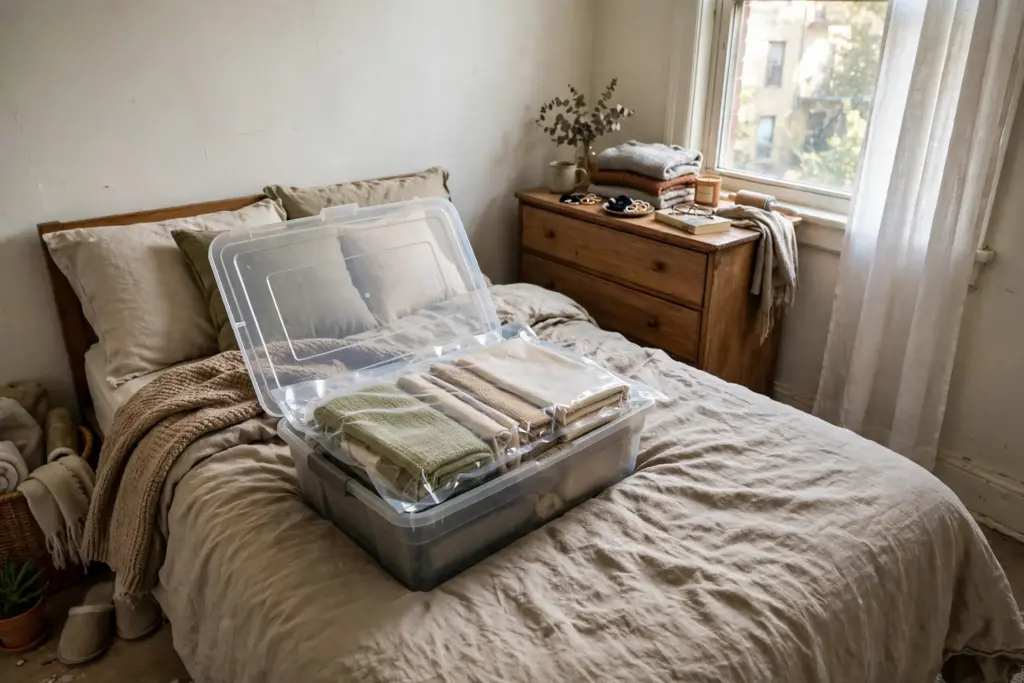
The Swap Rule That Stops Growth
11. One Bin Out, One Bin In
One bin out, one bin in, at every season change. When the autumn set comes out, the summer set goes into the same zone before anything new is bought. This single habit is what keeps a small flat’s seasonal collection from growing past its storage, and it mirrors the rotation logic in toy storage ideas for small apartments, where the same swap keeps toys from taking over the floor.
12. Edit Before Storing, Not After
At pack-away time, At pack-away time, set aside anything broken, faded, or unused for two seasons running, and let it go. Storage is not a waiting room for decor that no longer earns its space; every piece kept is a piece that must be found, labelled, and housed next year. A smaller, better-loved set is easier to store and more enjoyable to put up.
13. Close the Season With a Safety Pass
Batteries out of every battery-powered piece and remote. Candles and anything heat-sensitive stored away from radiators and hot spots. Stored items kept clear of heaters, exits, and egress paths — never blocking a door or hallway. Nothing heavy up high, nothing fragile under weight, nothing damp. A five-minute pass now is what makes next season’s decorating start with unpacking, not repairs. These seasonal decor storage ideas for small apartments only work when the whole system is followed: one labelled home, inside the flat, with a swap rule that keeps it the same size year after year. If the tree, wreath, and small decor cannot all fit one physical zone, keep one labelled inventory list on the bin — it records which piece lives where, so the system still works across two zones. 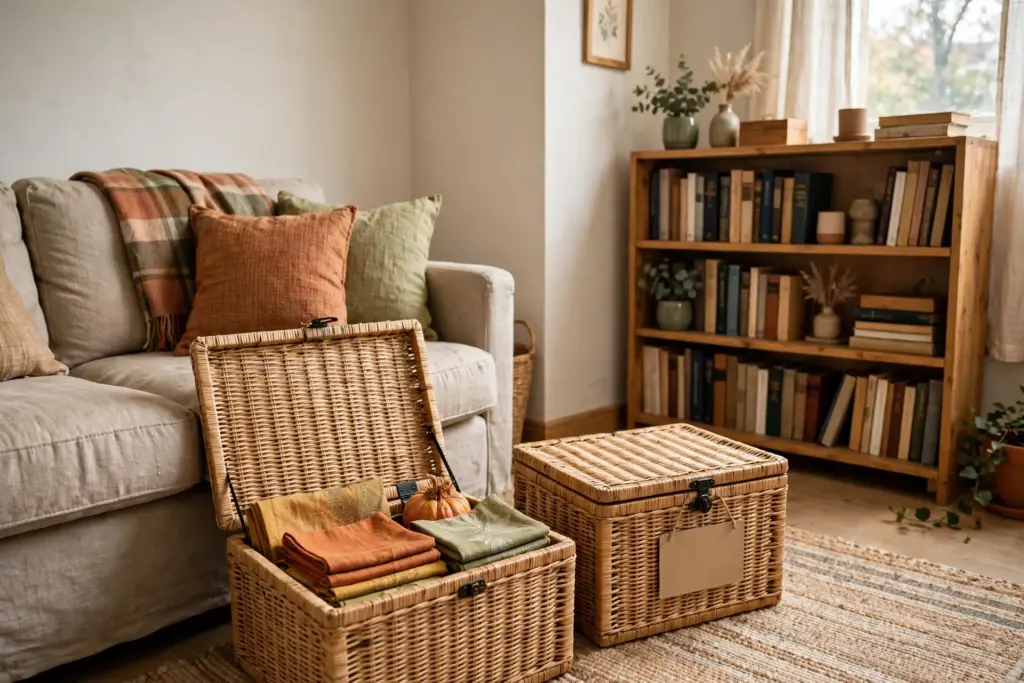
For more on keeping categories separated and labelled, the Public Storage guide to storing holiday decorations covers labelling by category and protecting fragile pieces, while the Fantastic Services complete guide to storing Christmas decorations covers wreath, light, and tree storage in detail.
Frequently Asked Questions (FAQ)
Where do you store seasonal decor in an apartment with no storage room?
Inside the flat itself: one under-bed bin run, one closet top shelf, one storage ottoman, or one behind-door zone. The winning move is giving every season one labelled home in a single zone, so the whole season can usually be found in under five minutes without a garage, basement, or spare closet.
Can you vacuum-seal ornaments or a wreath?
No — vacuum bags are for soft textiles only, like table runners, tree skirts, and throws. Ornaments, wreaths, and anything crushable will be damaged by the compression. Fragile pieces belong in divided or padded sections inside a rigid bin, or hung in a garment bag.
How do you store Christmas lights so they do not tangle?
Wind each strand around a stiff card, a cord reel, or a spare hanger, secure both ends, and store the coil flat with its clips and spare bulbs in a small pouch. Take batteries out of battery strands before storing, and keep the battery pack with the strand.
Is it safe to store decor on a high shelf or on top of a wardrobe?
Light items only up high, and never overload a shelf. Heavy bins belong low, where they can be lifted safely. Skip ceiling hooks and overhead installations in a rental — fixings are permission territory — and keep stored items clear of heaters, exits, and walkways.