
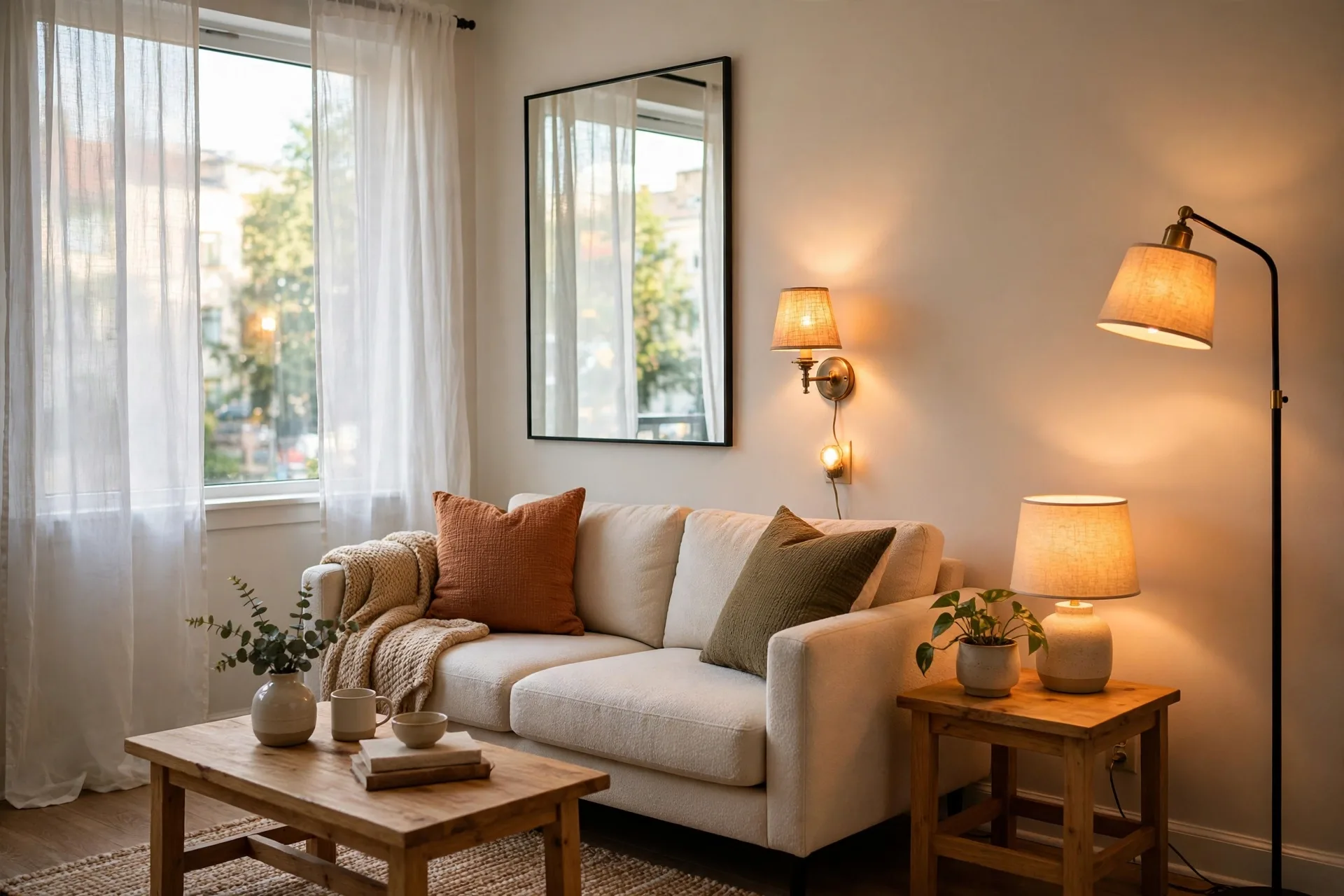
13 Renter-Friendly Lighting Ideas for a Dark Apartment
A dark rental is rarely a window problem. It is a lighting problem: one weak ceiling bulb, no overhead fixture at all, or corners that stay grey all day. These renter friendly lighting ideas fix all three without wiring, drilling, or an electrician — every idea below is plug-in, battery-powered, or adhesive-mounted, and packs up and moves with you at the end of the lease.
The 13 ideas are organized by the problem they solve: no ceiling light, one harsh overhead bulb, or dark corners with no windows. For a whole-apartment refresh, pair them with our guide to renter-friendly apartment decorating ideas.
Start With the Bulb: Lumens and Color Temperature
Before buying any fixture, fix the bulbs. Brightness is measured in lumens, not watts — watts only tell you how much energy a bulb uses. The Federal Trade Commission’s bulb guide gives the benchmark: a traditional 60-watt bulb produces about 800 lumens, and an LED needs only about 9 watts to match it. For overhead-level brightness, look for roughly 1,600 lumens, the old 100-watt equivalent — the same conversion appears in Fairfax County’s guide to energy-efficient lighting.
Color temperature matters just as much. Bulbs are rated in Kelvin (K): 2700K–3000K reads warm and suits living rooms and bedrooms, while cooler temperatures suit task zones like a desk or counter. The most common rental mistake is mixing temperatures in one room — a warm lamp beside a blue-white ceiling bulb makes both look wrong. Pick one temperature per room and match every bulb in it.
No Ceiling Light at All? Start Here
Many rentals have a switched outlet instead of a ceiling fixture. That is not a dead end — it just means the “overhead” light arrives by cord instead of by wire.
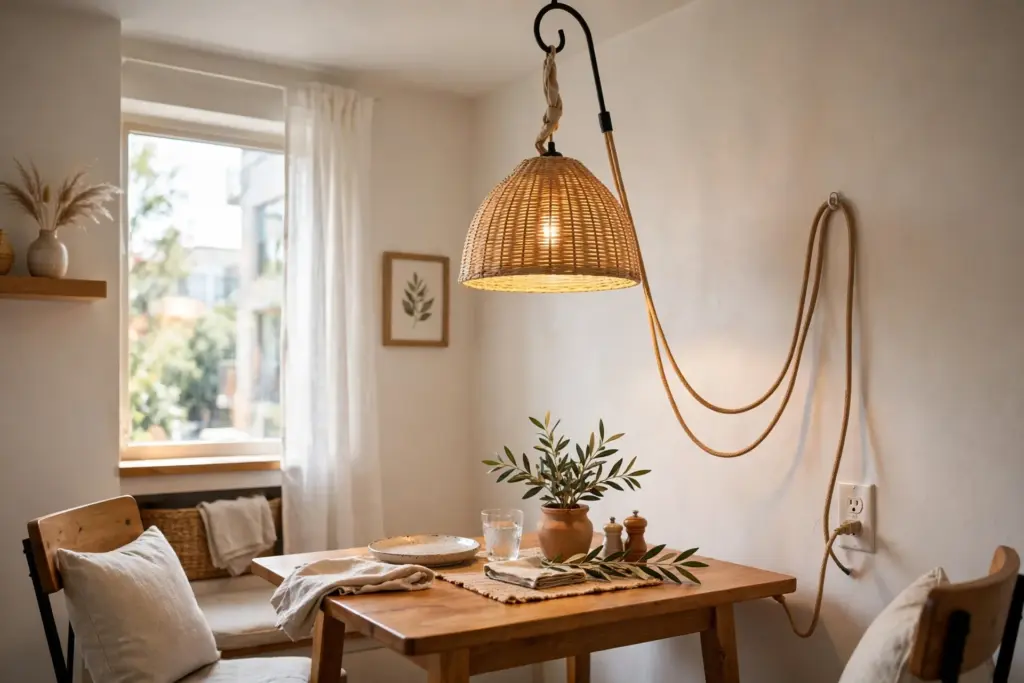
1. Hang a Plug-In Pendant on a Swag Hook
A plug-in pendant is the closest a renter can get to a hardwired ceiling light. The shade hangs from a hook above the table, and the cord swags across the ceiling and down the wall to an outlet. Use a hook rated for the fixture’s weight, tidy the cord with adhesive clips, and choose a wide shade that throws light down and out. Over a dining table, hang it roughly 30 inches above the tabletop.
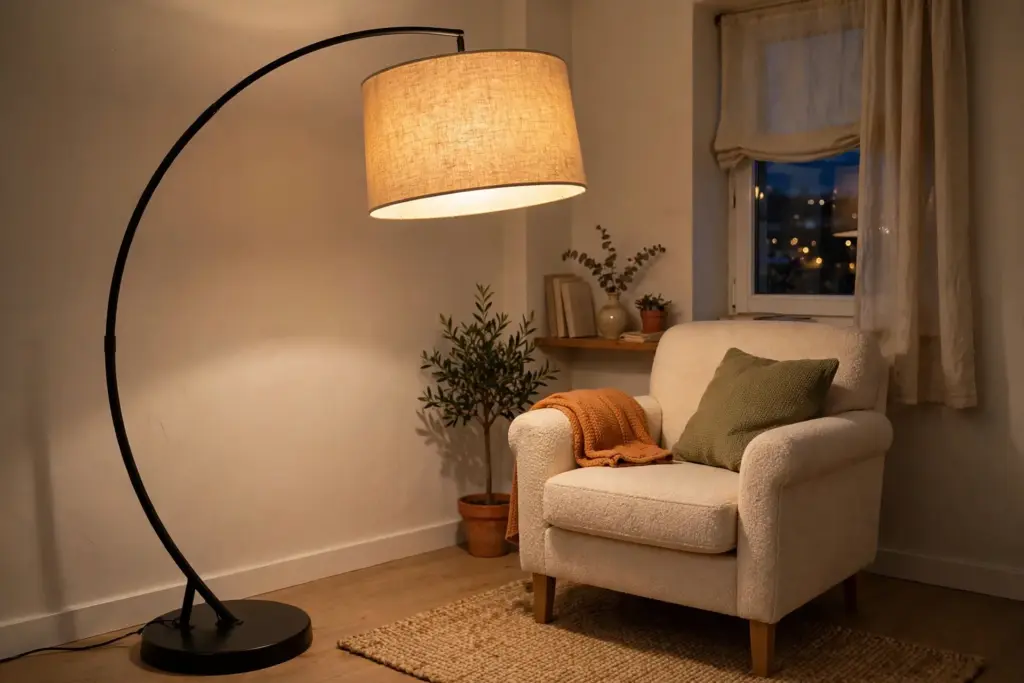
2. Arc a Floor Lamp Over the Seating
An arc floor lamp puts light where a ceiling fixture would — above the sofa or reading chair — while its base tucks behind the furniture. Check the arc’s reach before buying: the shade should land over the seat, not hover short of it. A fabric shade softens the output, and a 1,600-lumen bulb makes it strong enough to be the room’s main light.
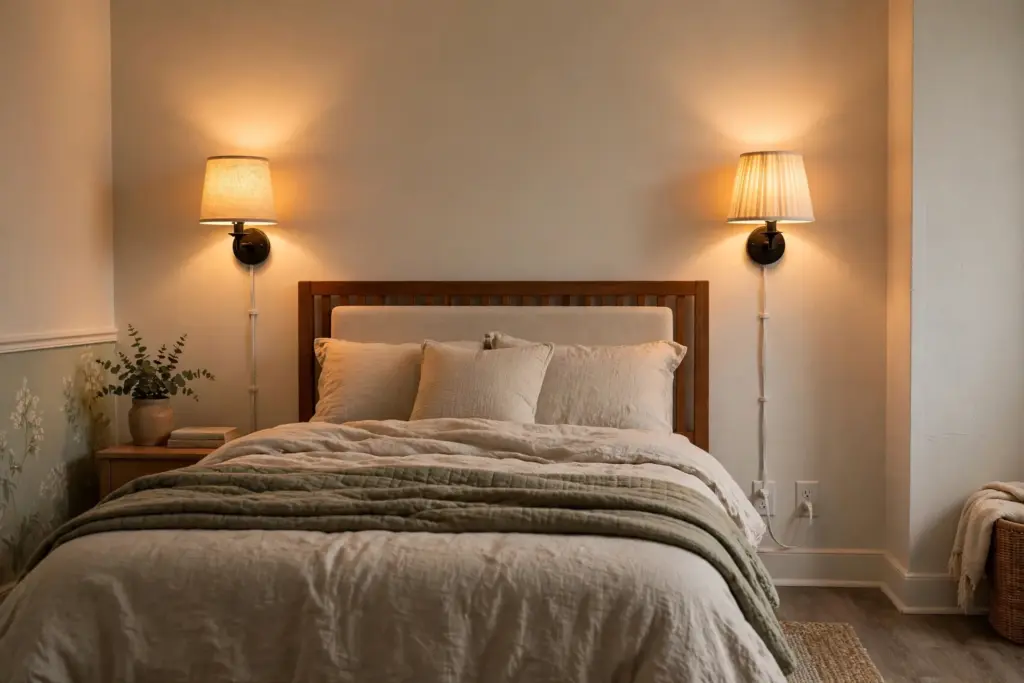
3. Add Plug-In Wall Sconces
Plug-in sconces deliver the built-in look without touching a wire. Mount them beside a bed or flanking a sofa, then run the cord to the outlet inside a paintable cord cover so the line reads as deliberate. If your lease forbids screws, choose lightweight models on adhesive strips rated well above the fixture’s weight, and test the mount in a hidden spot first. A matching pair makes a room feel planned, not patched together.
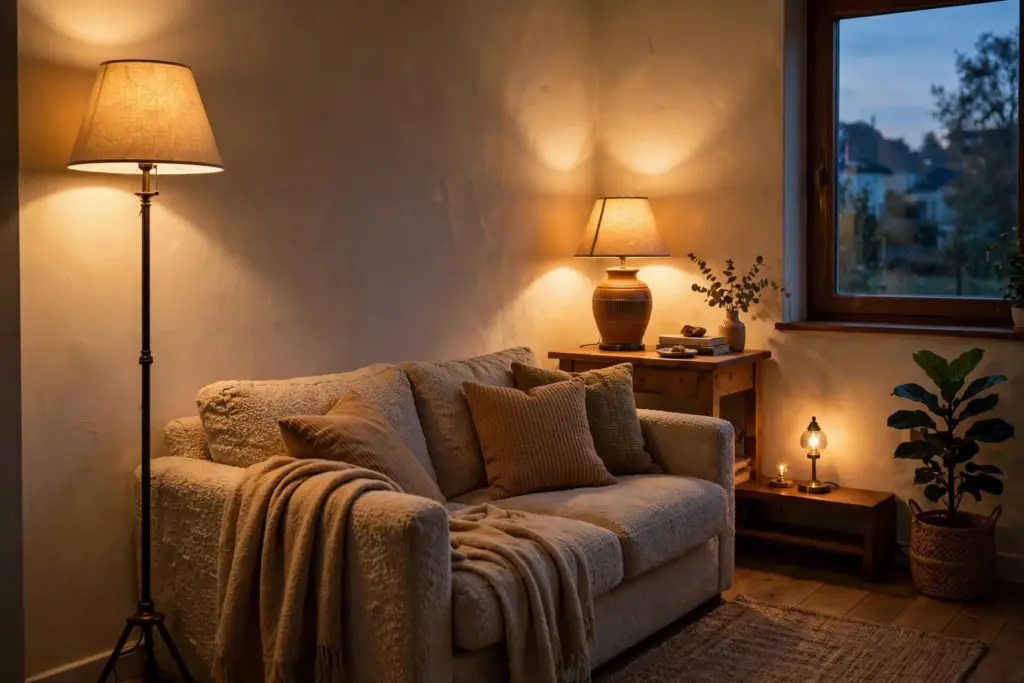
4. Layer Lamps at Three Heights
One lamp in a corner lights that corner. Three lamps at different heights — a floor lamp, a table lamp, and a small accent lamp on a shelf — light the room. Layering is the principle behind most of the stronger renter friendly lighting ideas: ambient light for the whole room, task light where you read or work, and accent light to wash away shadows. Keep all three on one color temperature, on separate switches, so the room can shift from bright to calm.
One Harsh Overhead Bulb? Soften It
The opposite problem is just as common: one bare ceiling bulb blasting the room with flat, cold light. You usually cannot replace the fixture — but you can overrule it.
5. Swap In Warm, Matched Bulbs — Then Turn the Overhead Off
If the fixture has a replaceable bulb, swap it for a warm 2700K–3000K LED and keep the original in a labeled box for move-out. Dimmable bulbs on a plug-in dimmer, or app-controlled smart bulbs, let you drop the overhead to a low glow. Most evenings, the winning move is simple: overhead off, layered lamps on — light at eye level feels warmer than one point on the ceiling.
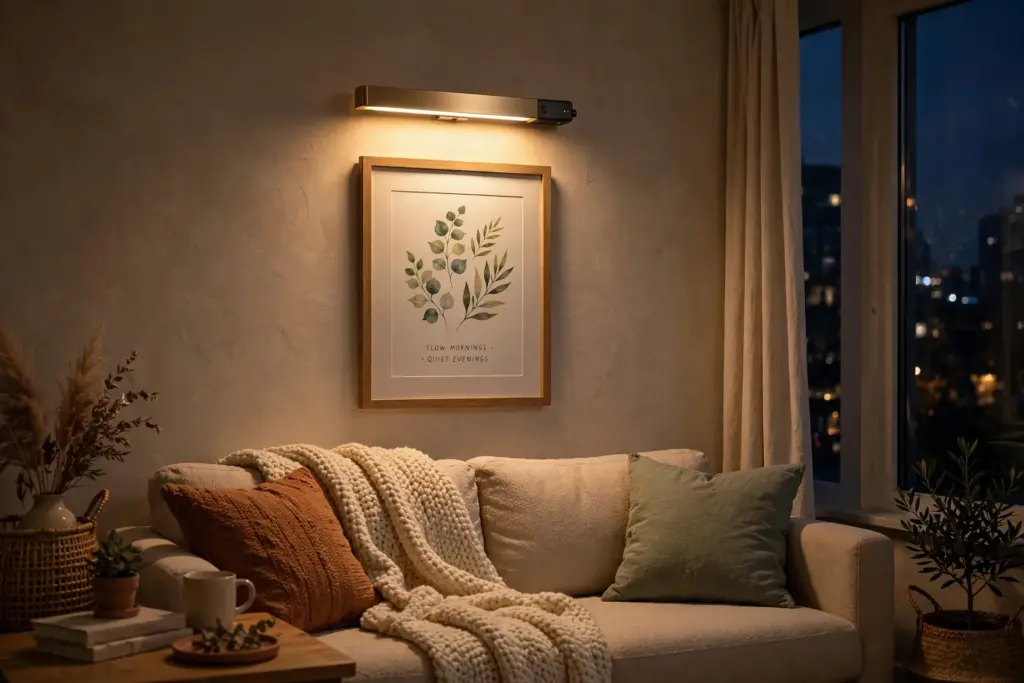
6. Add a Battery Picture Light Over Art
A slim battery picture light above a framed print highlights the art and washes the wall around it with a soft pool of light. Most models recharge by USB and mount to the frame or with adhesive, so there is no cord to hide. It pairs naturally with the no-nails arrangements in our renter-friendly wall decor ideas — hang the art without holes, then light it like a gallery would.
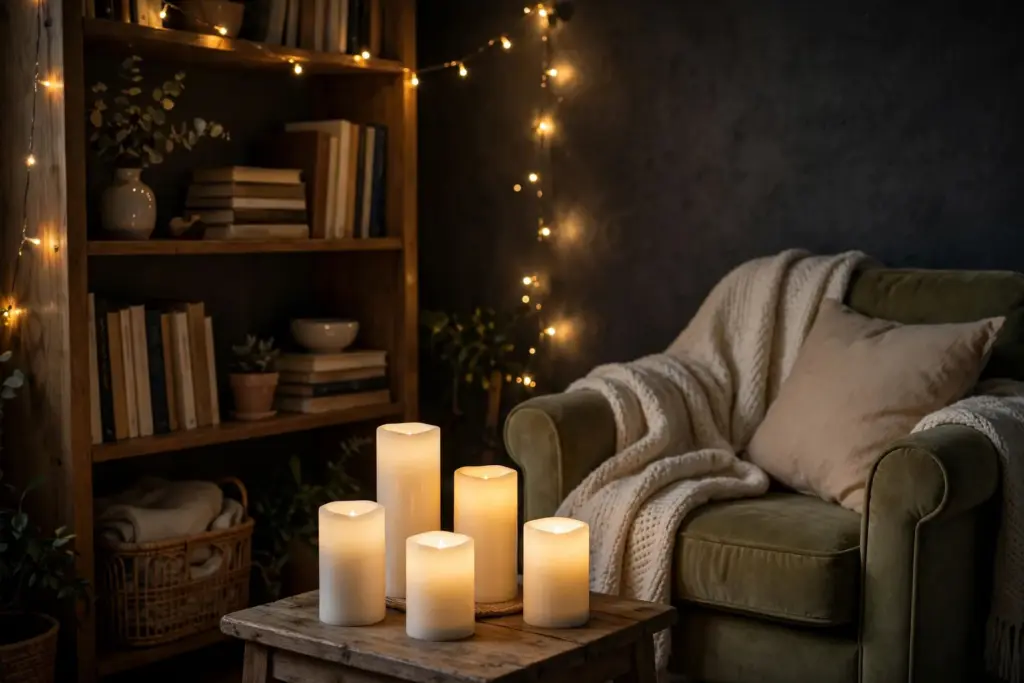
7. Use Flameless Candles and String Lights for Accent
Accent light is not about brightness — it is about removing the “one bulb” feeling. Group flameless LED candles on a shelf or coffee table and run warm string lights along a bookcase or bed frame. Flameless matters in a rental: real candles are a fire risk in small spaces and are banned in many leases. Battery and USB string lights avoid the outlet hunt, and a timer means the glow is waiting when you get home. Keep this layer warm and dim; it supports the lamps rather than competing with them.
Dark Corners and Windowless Spots
Kitchens, hallways, and interior bathrooms collect a rental’s darkest zones, and they are usually task zones — exactly where weak light is most annoying. Small, targeted fixtures beat one brighter bulb here.
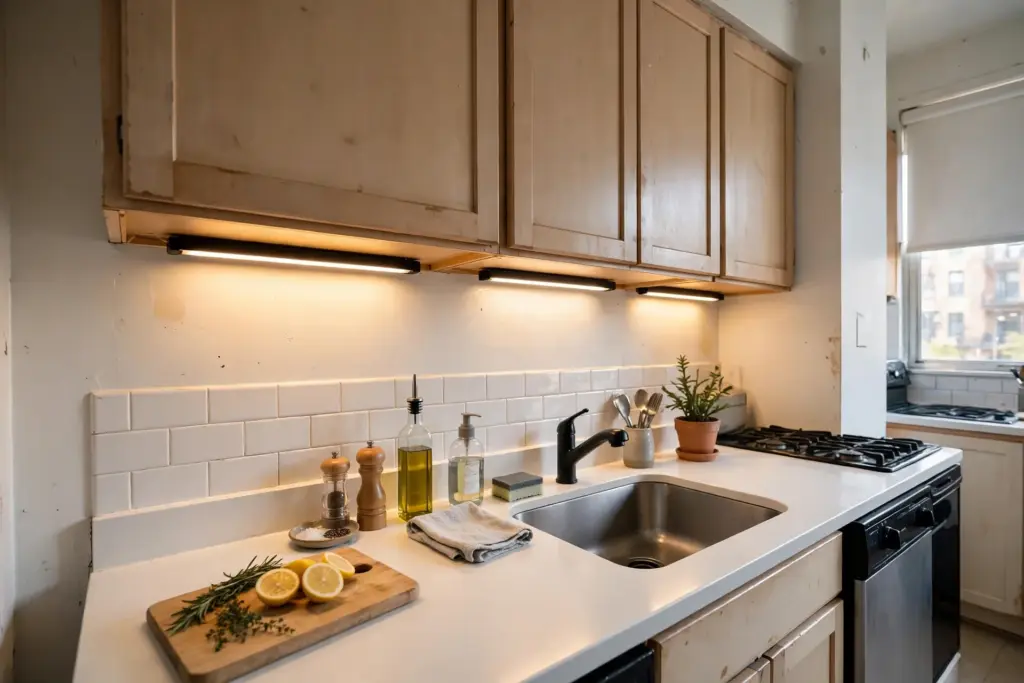
8. Stick Rechargeable Bars Under Cabinets
Under-cabinet light bars are the highest-impact kitchen fix a renter can make. Rechargeable models mount with adhesive or magnetic strips under wall cabinets, light the counter directly, and pop off for USB charging. Motion-activated versions switch on as you approach at night. Clean and dry the surface first, and keep bars away from direct steam — check the manufacturer’s placement guidance near sinks and stoves. Two or three bars cover a small kitchen run.
9. Run Adhesive LED Strips Along Shelves and Desks
LED strips hide under shelves, behind a media console, or along a desk edge, washing the surface below with indirect light. The strip itself stays out of sight — you see the glow, not the dots. Match the strip’s temperature to your lamps so the effect stays seamless. The adhesive backing removes at move-out: peel slowly at a low angle, and test a short section first.
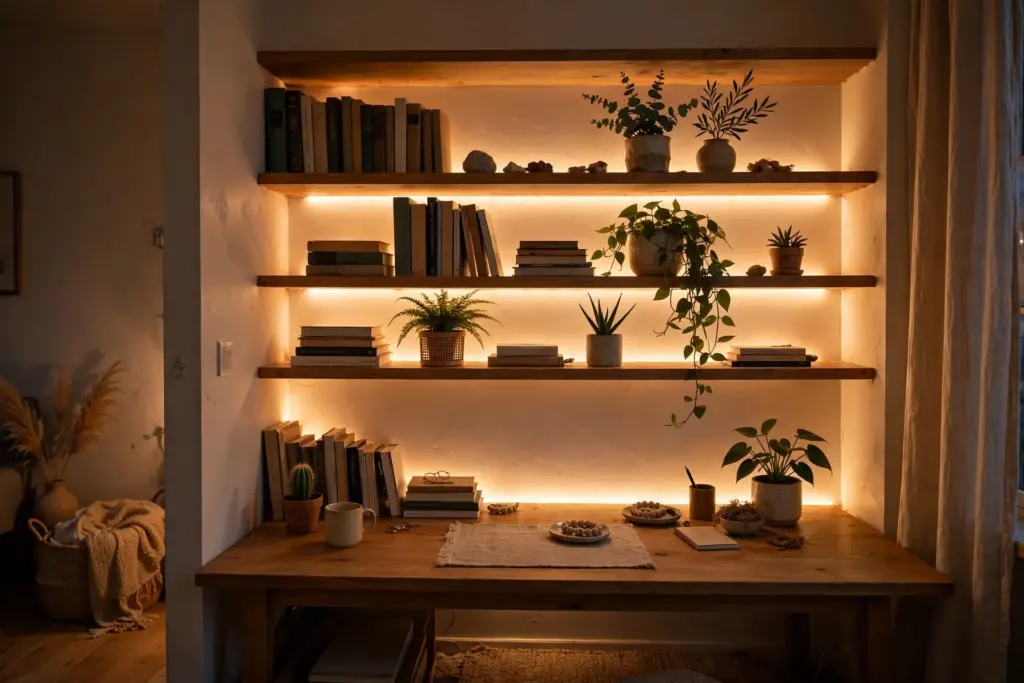
10. Drop Puck Lights Into Dead Zones
Rechargeable puck lights solve the spots nothing else reaches: inside a dark closet, above a bathroom mirror, in a deep pantry cabinet, or over an entryway console with no nearby outlet. Tap-on and remote versions both exist; remotes are easier when the puck sits high. Treat pucks as supplements, not main lighting — their job is to erase one specific shadow. Keep a charging cable in the same cabinet so recharging becomes a habit.
Let Daylight Work Harder
In a genuinely dark apartment, the cheapest brightness is the daylight you already have — most rentals waste much of it.
11. Put a Mirror Opposite or Beside the Window
A mirror placed opposite a window catches daylight and throws it back into the room; beside the window, it spreads light across the darker wall. Lean a large mirror on a dresser or the floor if your lease restricts hanging hardware, and anchor the base so it cannot slide. Mirrors also bounce lamplight at night, so the trick keeps working after sunset. Size matters more than ornament — the bigger the mirror, the more light it moves.
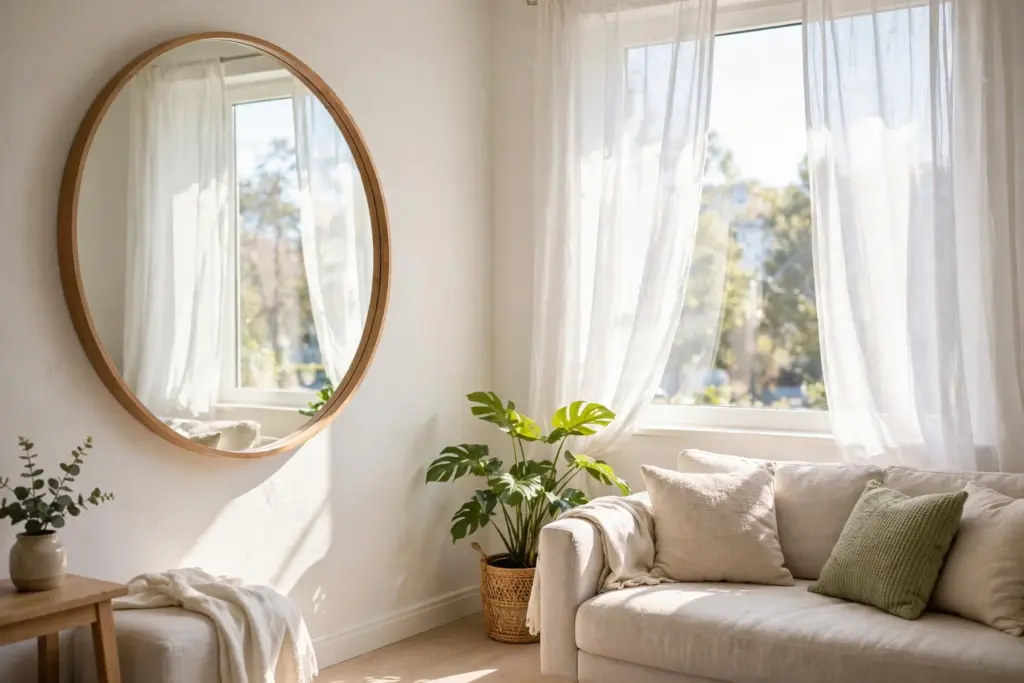
12. Swap Heavy Curtains for Sheers
Thick drapes and landlord-issue blackout blinds cut a room’s daylight dramatically even when “open.” Sheer or light-filtering curtains on a tension rod inside the window frame soften glare while letting most of the light through — no hardware at all. Keep the original curtains folded in a labeled bag and rehang them at move-out. For privacy, choose a denser sheer and test it from outside at night with the lights on first.
13. Choose Pale, Reflective Surfaces Near the Light
Dark lampshades absorb the light you paid for; pale fabric shades pass and spread it. The same logic applies to nearby surfaces: a light throw on a dark sofa by the window, a pale rug under the seating, or a light peel-and-stick accent wall — chosen with our peel-and-stick wallpaper guide for renters — reflects more light than the dark surface it replaces. Give the light in the room something to bounce off.
Two Permission Traps to Avoid
Swapping a hardwired fixture. Replacing a ceiling fixture or wired sconce means touching the building’s wiring. Some landlords allow it if the original is kept and restored at move-out; many leases forbid it outright. Get written permission first, or skip it — plug-in and battery options now cover the same ground.
Overloading strips and cords. More lamps should never mean daisy-chained power strips running a room. Extension cords are a temporary solution, not permanent wiring — Emory’s safety office, summarizing U.S. Consumer Product Safety Commission guidance, warns against plugging power strips into one another and overloading cords beyond their rating. Plug lamps into wall outlets, keep cords out of walkways, and use LED bulbs only near fabrics.
Frequently Asked Questions (FAQ)
How can I brighten a rental apartment without any wiring?
Use fixtures that plug in, run on batteries, or mount with adhesive: plug-in pendants and sconces, arc and table lamps, rechargeable under-cabinet bars, adhesive LED strips, and puck lights. None changes the building’s wiring, so nothing needs an electrician and everything removes at move-out.
What is the best lighting for an apartment with no ceiling lights?
Layer three heights of light: an arc floor lamp or plug-in pendant for ambient light, table lamps at seat level, and a small accent source such as a picture light or string lights. Match every bulb to one color temperature — 2700K to 3000K for living spaces — so the layers blend into one even glow.
Are plug-in sconces and pendants allowed in rentals?
Generally yes, because they plug into an outlet like a lamp and do not alter the wiring. The lease-sensitive part is the mounting: check your lease before using screws, choose adhesive mounts rated above the fixture’s weight where screws are not allowed, and restore any holes before the final walkthrough.
How many lumens do I need for a living room lamp?
A main lamp that carries a room should be around 1,600 lumens — the LED equivalent of an old 100-watt bulb. Table and accent lamps can be lower, around 450 to 800 lumens each, because layered sources add up. Judge the room with all layers on together, not bulb by bulb.
The Bottom Line
A dark apartment is a solvable problem. Start with matched warm bulbs, add one overhead-style fix — a pendant or an arc lamp — then layer task and accent light where shadows live. These renter friendly lighting ideas need no wiring and no deposit deductions: when you move, the light moves with you.